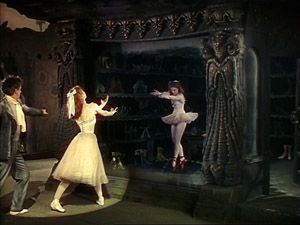
 What a revelation this film was. I generally try not to know much about a movie before I see it, and films like this really reward that diligence. I had no expectation going in that I'd see the kind of magic that The Archers put together here. It's a great balance, really, because so much of the film is just straightforward, natural narrative. But in a few moments, and of course in the eponymous extended dance sequence, it slips very naturally into something else. I was searching for what to call it—words like 'surreal' and 'magic' don't seem to fit at all—when I ran across the perfect phrase in a British review: "quietly radical." It's not designed to shock you. It's not even designed to amaze you. It's just that the filmmakers make full use of their medium, while keeping everything perfectly in line with the story they're trying to tell. They manage it beautifully—I was more impressed with their ability to do that than I was with the technical wizardry itself, which is exactly as it should be.
The story itself is not overly original, but it's well told. The more traditional scenes of the film were typically well crafted, of course. The narrative is absorbed in the world of the ballet. As usual with The Archers, the techniques are subtle, but effective. Much of the action takes place in long shots, for example—we often see three or four main characters on screen. Everything seems to happen in a larger context, and the story isn't dominated by the very strong personalities within it. They certainly are strong, though, and propel the story forward nicely.
I did find myself comparing it to (or maybe rather, considering it alongside) Black Swan, and it really has me wondering about this common trope of a woman's self-destructive obsession with her art. Not that there aren't similar male tropes, and not that there aren't other obsessed-female character types. But from Sunset Boulevard through this film and on to today, it seems that a woman is never allowed to be too devoted to her art. It's difficult to imagine such films with the gender roles flipped.
It isn't really a problem (internally) with this film, mind you. Vicky is a full character, not just a trope, and her development as a character is enthralling to watch. Shearer gracefully toes the line between naturalistic and romanticized acting, and it serves the story well. The same is true, by the way, of the two male leads. Anton Walbrook's Lermontov is especially charismatic. He's difficult to love, but hard not to pay attention to. (I don't mean to tie this film too much to Black Swan, but that film would have been greatly improved if Thomas Leroy had been written & performed with more of this subtle charm.)
The Red Shoes was a thrill to watch, and I'm grateful to Filmspotting for turning me on to it. And to The Archers overall—I can't wait to see more from them.