Kristian Matsson's music doesn't so much have rough edges as it does rough surfaces. There's an ever-present struggle in his voice, and to a lesser extent in his playing. He seems always to be a bit beyond his comfort zone, stretching to reach a higher note or a more expansive idea. It's easy to be fooled, but that unfinished sound belies the solid structure underneath. In a sense, what makes the music so compelling is that tension between the easy, solid base and the gritty, rough-hewn surface. There is an easy confidence in the songwriting; it's music with a lot more heart than head.
If the music is dependably good, that isn't to say it's static. TMoE is breaking new ground on this album, departing from the guy-with-a-guitar sound that has comprised virtually his entire catalog up to this point. If you stop and pay attention, it's not difficult to imagine how a song like "Revelation Blues" would sound without the atmospherics, rhythm section, etc. But if you take it all at face value, the sound is quite organic.
Nothing sounds like it should be stripped bare, even if you can hear how it could be. The focal point is still Matsson's intricate picking, and that's as gorgeous as ever. If the additional instrumentation & production don't seem integral to the end product, they do add a freshness to his music. This seems like the most organic direction for TMoE's music to grow, and it's good to see him working his way into it.
Mostly, There's No Leaving Now is shot through with grace and beauty. Sometimes it's the songwriting, as on the title track. Often it's Matsson's guitar playing. Occasionally it's just the straining of his voice in fleeting moments, as in the final track. It's another masterful album, which certainly holds up to the high expectations that are resting on it.
Showing posts with label 2012. Show all posts
Monday, June 11, 2012
Monday, June 4, 2012
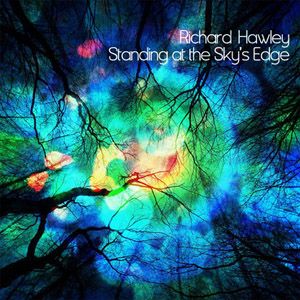
Richard Hawley — Standing at the Sky's Edge (2012)
Richard Hawley's latest album, like one or two before it, fades in slowly. As the sound rises from nothingness, you'll be forgiven if you expect his typical reverb-laden Rickenbacker sound to wash over you. Don't get too comfortable, though—when this album comes on, it hits like a brick wall. With the opener, "She Brings the Light," Hawley is clearly in new territory, and he spends most of the rest of the album exploring it.
There's never been a real throughline in Hawley's album releases. He has always had something of a signature sound, to be sure, but his development from album to album hasn't always followed a clear course—he hasn't been consistently getting heavier, or lighter, or grander. Still, this album feels like a real departure. Beyond the wall-of-sound opening, he's working here with a lot of sonic elements that aren't familiar from his previous work. The title track's bongo interlude, for instance, or the spacey over-production of "Time Will Bring You Winter," will surprise longtime fans. The thing is that these elements work—the sound is mature, fleshed out. If this were the first Richard Hawley album you'd ever heard, you'd have to assume he'd been developing exactly this sound for quite some time.
He does momentarily return to more familiar ground for the pairing of "Seek It" and "Don't Stare at the Sun." They're not bad, but it's not the best material here. Certainly, they don't integrate seamlessly into this album—in the context of so much volume, such songs take on a quaintness that doesn't well suit them. Then again, perhaps it's that Hawley himself is moving on from such spaces, and his lack of engagement is showing. "The Wood Collier's Grave" seems to indicate the latter—simple as it is, it works beautifully, and tracks perfectly back into the crashing "Leave Your Body Behind You." Evidently, Hawley is ready for a new sound. But if this album is any indication, he'll be just as comfortable and masterful as ever.
Saturday, March 24, 2012
Anya Marina — Felony Flats (2012)
On the surface, it's easy not to take Anya Marina seriously—the wispy voice, the bottle-blond hair, the coy album cover. And musically, what she's going for isn't terribly complicated. She makes broadly palatable music, borrowing a lot from various genres. A lot depends on the execution. Her approach is a template, and with enough depth and complexity, it can really work. On this—as on her previous albums—there are moments where she pulls it off. "Believe Me I Believe" is a solid example. Her voice drifts in and out of darkly textured electronic polyrhythms, and the contrast is superb. "Heart Stops" achieves the same effect, this time setting her against a lilting bassline and a wall of guitar. Despite very little actual structure, these spaces do give the listener plenty to explore. If she could carry it off for an additional half-hour or so, it would be one hell of an album. Unfortunately, she can't, and moments like this leave one wishing.
In the end, "borrow" is the right word for what Marina is doing. She doesn't immerse herself in any of these genres; she always seems like a visitor. She dips her toes in the acrid waters of punk, grunge, etc., but always there is the sheen of a top-40 star. This formula is exactly what's landed her on buzz-making commercial spots and soundtracks, of course. Such venues exist all around the edge of the mainstream, her home turf. Marina never gets lost in her wanderings; there's always a hook around the next corner. It's easy to listen to, for sure, but after a while it takes some effort just to stay engaged.
That said, and no backhanded compliment intended, maybe it's better not to try and stay engaged. For what it is, Felony Flats is close to pitch-perfect. Marina is alluring, more than fascinating. Her music exists comfortably in the background while you're doing something more interesting, calling your attention just often enough to add to the experience. But never enough to really captivate you.
Friday, February 10, 2012
The Little Willies — For the Good Times (2012)
There's a lot to like about The Little Willies' long-awaited sophomore release. They're certainly talented, and can be an engaging listen. But the first and last word that will come to mind as you think of The Little Willies must be "fun." Incessantly, doggedly, sometimes tediously fun. Not that there's anything wrong with fun music, of course, and some of the songs here are as good as they've ever been ("If You've Got the Money I've Got the Time" comes to mind).
One might take a bit of offense to how The Willies strip mine classic songs for the extraction of this one pure resource, of course. Even related notions like rowdiness ("Fist City") or sarcasm ("Wide Open Road") are dispensed with in favor of the distilled product. When virtually every song seems to produce a certain mood, one has to wonder whether it's because every song was approached as a means to that end. After the first half hour or so, one might also start to find the whole exercise a bit monotonous.
To be fair, there are a few moments when they're not extracting every drop of bouncy joy from a tune. Some of these—say, for instance, "Permanently Lonely"—suffer from a certain lack of engagement, and do little to mitigate the overall feeling. But when Jones takes over the microphone for the album's final sequence, she ably sells a wider range of emotion. The title track, "Jolene", and "Pennies on the Floor" are all effective. Gathered as they are at the end, they help the album ride off into a convincing sunset.
To some extent, though, it's that lack of engagement which really defines the album. Like many side projects, the performers often seem unable to fully commit. It has the feel of a backyard barbecue performance, where no one's willing to be accused of taking the whole thing too seriously. There are bright spots—the aforementioned "If You've Got the Money" and the opening track, "I Worship You," are firmly in this mold, and work beautifully. But it's not enough to sustain a full album, and the overall product is inconsistent. For my part, I'll give 3 or 4 stars to a few of the songs, and be glad to hear them when they come up on shuffle play. But I doubt I'll revisit the album itself very often.
Subscribe to:
Posts (Atom)