Showing posts with label terrence malick. Show all posts

Thursday, March 1, 2012

Days of Heaven (1978)


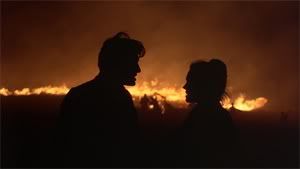
So, I've finally found a Malick film that I'm not wild about. There's plenty to like, and I can certainly see why a lot of people consider it a masterpiece. It's gorgeous, of course—almost every shot is a stunner—and yet that really doesn't detract from the story, which isn't always a given in auteur films. Other technical aspects of the film—the sound especially, and I don't just mean the music—are also quite impressive, and again serve the story well. So far, so good.

But then, there's the actual story. It's certainly pretty standoffish, as far as the emotion goes, but that's so obviously a conscious choice that I have to regard it as disciplined storytelling. The dryness of the telling was certainly in keeping with the film's locale, and the two feed back into each other pretty naturally. So I really didn't mind it. For the most part. I do think, though, that putting Richard Gere in this role was one of the worst casting choices I've ever seen. Especially at this age, Gere is completely incapable of a non-arrogant moment. It's not that he can't display, or even explore, other emotions—sadness, hopelessness, joy, love, envy, or playfulness, for example. It's just that in every one of those moments, his character also seems to be completely full of himself, assured of his own greatness. It doesn't serve this role well. Bill is a character with a lot of brashness, to be sure. It's his driving force, really. But he goes through several significant transformations in the course of the film, and during some of those transitional moments, his self-assuredness doesn't ring at all true. In those moments, the emotional tone of the film doesn't seem dry so much as shallow.

What bothered me much more, though, was the deep misogyny underlying the whole thing. On a second viewing, especially, I was struck by what a slight character Abby really is. If the whole film turns around her, and I think it does, that doesn't mean that she herself is actually important. Rarely does the film, or any one of its characters, ascribe her any real agency. Her fateful decision to go with The Farmer isn't even really her decision, as we're reminded several times. Bill pushes her into it, and she just goes where she's told. Neither does her relationship with The Farmer seem to have any real substance. In a way, she seems to exist simply as an object of desire for both men, and the central conflict of the film is actually just the overlapping of their desires. It's almost homoerotic, frankly. The two men are intimately connected, even though all they really share is a lover.

There's a lot to the film, and I'm certainly glad I watched it (both times). But I didn't come around to it, and I doubt I will try again.

Wednesday, June 1, 2011

Badlands (1973)


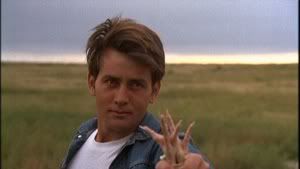
If nothing else, Terrence Malick is a patient filmmaker. He is content to simply spend time with his characters, letting them develop organically rather than putting them through a series of dramatic plot points which can define them clearly. This film develops at its own pace. We watch as Kit spends the morning dumping trash for the city, noticing little details about the people and places along his route and joking around with his co-worker. There's a bit more drama in Holly's narration, but it's muted simply by virtue of being narration, and of course through Spacek's deadpan intonation of it. Though there are moments of foreboding and drama, just as often there are significant moments which pass by almost undetected. The first time we see Kit's gun, for example, it's just there in his pocket as he's moving around Holly's room. This patient, hyper-realist style is an interesting choice, and it has the effect of bringing down to ground level what would otherwise be a larger-than-life story.

The ancillary effect of the style is that it lays the burden of the story directly onto those in front of the camera. It's a great choice, though—if Martin Sheen and Sissy Spacek can't carry your film, it can't be carried. They each fill out their characters wonderfully. Sheen is a charismatic presence immediately. On the page, his character is not so much quirky as deranged, but Sheen manages to lend an air of intrigue to Kit, and to weave his meandering thoughts into a mostly fluid line. For her part, Spacek develops an admittedly personality-free girl into a willful, moral presence.

I had expected this to be a much more somber film, but Malick is playful—most obviously with the music, but also with the irony in Holly's telling of the story, and with the interactions between this pair and the strangers they meet. It's an offbeat film, and an infectious one.