Showing posts with label movies. Show all posts

Friday, August 31, 2012

Animals Are Beautiful People (1974)


If you've never seen The Gods Must Be Crazy, this movie will probably be pretty surprising. If you have seen it, this should still be awfully entertaining. Animals Are Beautiful People is offered more as a straightforward documentary than is its obviously-fictional descendant, and that pretense makes a beautiful stage on which to present this parody. Filmmaker Jamie Uyr treads the line carefully, and manages a nearly pitch-perfect comedic documentary (a rare genre indeed, and certainly not to be confused with the more familiar mockumentary).

Actors, directors, and writers have long argued that comedy is much harder than it looks, and specifically that it requires real commitment if you're going to pull it off. This is Uyr's strongest asset. He does have some great footage of the animals & plants which populate the deserts of southern Africa. The film is rife with can-you-believe-it facts, just as any nature documentary would be, and most of them seem to be true. This is, at its core, a nature documentary. A careful observer may notice some liberties in the editing, and elsewhere, but they are infrequent and subtle enough to be harmless. And they do serve the tone of the film well.

It's that tone that sets the film apart. Certainly no straightforward documentary would describe its subjects with the casual, judgmental, and even mocking lines that fill out most of the narration here. It comes on gradually, though, and Paddy O'Byrne speaks with just the right amount of irony to sell it but not oversell it.

It's a well balanced film, with plenty of levity punctuated by serious—even grave—moments, and humor laid casually over a documentary's worth of interesting factual information. Mostly, it's just surprisingly fun to watch. I'm sure I'll be watching it again soon (with the kids), and I'm hopeful it will hold up well.

Thursday, August 9, 2012

The California Kid (1974)


This is a made-for-TV movie, and it shows, especially in the production values and the music (more about the latter in a minute). I certainly wouldn't have watched it if it hadn't been freely available on YouTube. That said, it was a lot of fun, and the characters were surprisingly interesting (relative to other TV movies, of course).

The biggest draw, apart from the free-ness, is the star. Martin Sheen is the eponymous lead, and brings a boatload of charisma to a character who offers (and needs) nothing else. Nick Nolte shows up in a small but significant part, and hits the pitch perfectly. TV-movie star Vic Morrow could probably have done a bit more with the troubled, possibly-evil antagonist, but that is certainly asking too much from a made-for-TV flick. It would have been pretty disturbing if he'd gone any further with it, honestly.

It's a terse, tautly drawn drama, and if it doesn't do a lot to pull you in, it also doesn't give you much time for distraction. The action runs along fairly quickly, toward a pretty predictable end, but with a few interesting moments along the way.

And now a note about the music. The film is supposed to take place in the late 50s, but the music is pure 70s. And it's one of the best things about this film. It's so out of place that it pretty much takes over, and sets the entire mood. If you're not carried away by the wikkity-wah-wah of the opening credits, don't bother watching any further. Music is the raft that will carry you down this river, and if you can stay on board, it's a fun ride.

Thursday, July 26, 2012

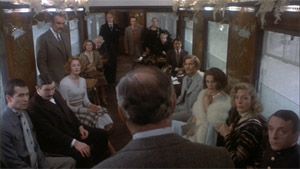
Murder on the Orient Express (1974)


If this film is evidence of anything, it's that a collaboration among the best & brightest doesn't always produce the greatest result. Story by Agatha Christie. Directed by Sidney Lumet. An all-star cast, including Albert Finney, Lauren Bacall, Ingrid Bergman, Sean Connery, John Gielgud, Anthony Perkins, Vanessa Redgrave, and Richard Widmark. This thing can't fail.

And it doesn't, exactly, but it really doesn't succeed either. There are a few of the standard Poirot lines ("What a funny little man", "You're Belgian? I'd thought you were French."), but no real wit. Nothing popped; the movie just plods along through a fairly routine (and largely telegraphed) whodunit. From that entire cast of stars, there's not a single noteworthy performance. The best thing you can say is that some of them managed to really disappear into their roles (Finney & Bergman, especially). But what a movie like this wants is some sparkle, some charm. Only Perkins, of all people, brings any of that, and it's certainly not enough to go around.

And finally, I have to mention the two lengthy scenes near the end—the re-enactment of the deed, and the champagne toasts. Both were given entirely too much time and attention. I can't say much more without a spoiler, but they really drew out the end of an already too-long film, and to no positive effect.

Sunday, July 15, 2012

Terminator 2: Judgment Day (1991)


I'm not sure how much I'll have to say about this film, but it's a legitimate classic. I have some gripes with it—the rehashed battle scene at the beginning, the gratuitous images of a playground full of children being incinerated, and of course the completely superfluous narration. But those are relatively minor quibbles, and overall I enjoyed this quite a bit.

Following that opening battle sequence, we cut straight to the familiar scene of an arrival from the future into the present. This is better, on a technical level, than it had been in the previous film, and the follow-up (also familiar—the "Give me your clothes" scene) is better on a dramatic level. It's clear that more money was spent on this film, but also that more talent was at work on it. This is good, because while both films are strong pieces of science fiction, what really carries them both is the human story. And in this case, it carries quite a bit further than it had in the predecessor.

There's a level of intensity to the film from early on, and it's masterfully sustained. This is the case in spite of already knowing some of the major surprises (such as which visitor from the future was here to help and which wasn't), and even through some literally very dry scenes in Mexico. It's beautifully shot, reasonably well written, and the special effects are really remarkable even two decades later.

But mostly, it's well acted. I knew going in that Linda Hamilton was going to be the core of the movie, and I wasn't wrong. I was even impressed with Schwarzenegger, though, and with Robert Patrick. Ed Furlong wasn't so impressive, but he didn't drag it down. Still, it's Sarah Connor that really drives the story. The scenes that focus on her are the best throughout—tense, gripping moments that both hold the movie together and keep it in your mind after the credits roll.

It was a lot of fun to watch, and I'm already ready to give it another go. It wasn't a masterpiece, I don't guess, but it was awful good.

Tuesday, July 3, 2012

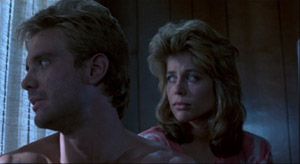
The Terminator (1984)


There's something enjoyable about this movie that's difficult to clearly identify. For starters, it's easy to underestimate the value of a great credits sequence, which this certainly has. The screen practically pulses with the gliding outlines of bold, futuristic logo text, and the synth score is a relatively minimal flow of ominous tones. It's nothing terribly flashy, especially by today's standards, but it lends a gravity to the film that will help to carry it along.

Then too, watching this for the first time in this day & age, it's nearly impossible to consider it apart from its acclaimed sequel. Like the character of Sarah Connor herself, this is a movie borrowing much of its significance from the offspring it will produce.

It's difficult, upon any reflection, to find a lot of value in the film itself. It's severely outdated in many respects—that score, certainly, and many of the special effects—and it does lean on those elements fairly heavily. As for the plot, it is utterly predictable (other than a brief, creepy interlude when it seems that Kyle Reese might actually be John Connor, just as the blossoming romantic subplot is about to bloom). That said, the actors' commitment to their roles does keep the whole enterprise afloat. And the special effects near the end—featuring the stripped metallic body of the terminator—are spectacular. So it was, overall, fun to watch.

It's worth seeing, I hope, but as Reese points out, the future I'm expecting is only one possible destiny. And if it goes poorly, this picture will look much less rosy in retrospect.

Thursday, June 21, 2012

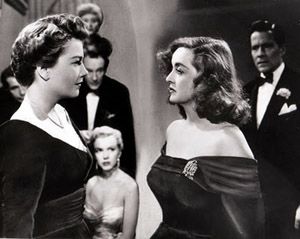
All about Eve (1950)


I had several problems with this film, but let me start with a few of the more minor. First of all, the characters seem more like...well, more like characters than actual human beings. There is very little depth or complexity to anyone—provided one doesn't confuse flakiness with complexity, but more on that in a minute. (The one exception is Thelma Ritter, who of course has more natural charisma and substance in her lower lip than most actors have in their entire body.) It's not just that people seem stiff, although for the most part they do. It's more than there seems to be nothing unseen, nothing that isn't there to fill out a generic character type or propel the plot.

Speaking of which, back to the question of flakiness vs. complexity. I'm all for inconsistency in a character's actions, so long as it seems to come from some depth or internal contradiction. That's the essence of drama, but it's not what's happening here. When the plot needs Margo to turn on Eve, she simply does so—there is very little evidence of any internal struggle. Karen Richards follows the exact same hairpin arc when it's her turn to further the storyline, and with only slightly more sense that something's at stake. The men, of course, are just so many set pieces, serving the same purpose that women tend to serve in a more traditionally misogynistic film—they exist to prove something about the characters of the opposite sex, or about gender relations at large, rather than to be identifiable personalities in their own right.

Not that the film is any less misogynistic for it, of course. Two of the three female leads are flakes, and the other—Eve herself—is a cardboard cutout. We're never given much of a clue as to her motivation, probably because even the filmmakers didn't think it would be very interesting. She's an ambitious ingenue, who will step on anyone in order to get up a rung. That's all the treatment she gets, but surely even she could have been much more intriguing. Her most captivating moment is indeed when she flashes her vicious side in the one-on-one with Karen, but why couldn't we at least have more of that? She plods through most of them film so robotically that it seems she has no drive at all.

Which brings me to yet another issue. The film is, of course, 'about' gender issues. In show business specifically, but in society in general. But at least as interesting a subject, especially given the question of Eve's motivation, would have been the issue of class. Which is thoroughly—systematically, even—avoided. Even as Addison DeWitt compares himself to Eve while simultaneously claiming to 'own' her, we're never given to ask why—why would one such person end up with all the power, while the other ends up trapped even in her own success? It's a bit to do with gender, yes, but as he himself lays out the case, it's obvious: the real issue is that her name is Gertrude Slojinski, while his is Addison DeWitt. She has had to fight and scrape her way up, while he has simply waited for her at the top. Eve's greatest sin isn't being a woman. It's being a climber.

And finally, if I can return to more minor complaints, the film is just so dry. Some films do well with a lot of dialogue, but this isn't one. Primarily because it isn't dialogue, so much as exposition and real-time analysis by the characters themselves. It could have been 45 minutes shorter, and an awful lot tighter, if they had just shut the hell up once in a while and let things happen.

In spite of these complaints, it's not a terrible film. There are moments of good acting, especially from George Sanders and the aforementioned Thelma Ritter. And there is a worthwhile, interesting story hidden in there somewhere, even if it's obscured by a lot of talking about it and looking in the wrong direction most of the time. This is one film that I'd love to see redone, especially with an eye to more tension and suspense.

Sunday, June 17, 2012

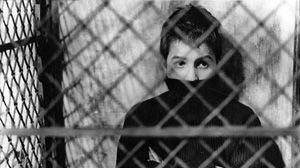
The 400 Blows (1959)


This film is like a smoldering fire, that never flares very high, but steadily, inevitably consumes its protagonist. Jean-Pierre Léaud does an amazing job in the lead role, setting the temperature of the entire film with his stoicism and reserve. He is in virtually every frame, which is a bit ironic since so much of what happens depends on everyone but him. The result is a claustrophobic sense of powerlessness. The audience is never given a way (or a reason) to identify with Antoine's parents or teachers; the world is simply there, at every turn cruel to varying degrees, but without any definitive reason why.

The whole of the film is masterfully designed and executed. Its boundaries are narrowly drawn, and within them it seems entirely complete. Truffaut's work is solid, plain, and immersive. Léaud's performance is well supported by those around him, especially his friend René, who is really the agent of Antoine's downfall, but without any malice or false intent. The contrast between the two is a subtle but illuminating study in what it takes to get ahead in the world.

Really, fire is the wrong metaphor for this film. Antoine isn't so much consumed as he is trapped. The movie's events unfold like a game of chess, and try though he might, he can't avoid that end. Still he never seems desperate, or for the most part even unhappy. The one exception—and certainly the most powerful moment in the movie—is his ride to the Observation Center (which parallels the marvelous opening-credits sequence). Léaud is in full control here, as we see the weight of misfortune settle heavily onto Antoine's shoulders. Still, he's soon back to his stoic self. In the end, though he has no clear path to a better life, as he stands on that seashore he does seem to have a glimmer of hope in his eyes. Here, as throughout the movie, one can't help but feel it with him.

Friday, June 15, 2012

The Red Shoes (1948)


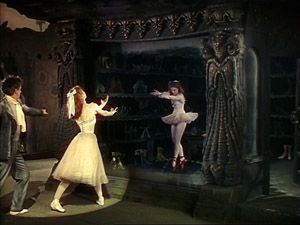
What a revelation this film was. I generally try not to know much about a movie before I see it, and films like this really reward that diligence. I had no expectation going in that I'd see the kind of magic that The Archers put together here. It's a great balance, really, because so much of the film is just straightforward, natural narrative. But in a few moments, and of course in the eponymous extended dance sequence, it slips very naturally into something else. I was searching for what to call it—words like 'surreal' and 'magic' don't seem to fit at all—when I ran across the perfect phrase in a British review: "quietly radical." It's not designed to shock you. It's not even designed to amaze you. It's just that the filmmakers make full use of their medium, while keeping everything perfectly in line with the story they're trying to tell. They manage it beautifully—I was more impressed with their ability to do that than I was with the technical wizardry itself, which is exactly as it should be.

The story itself is not overly original, but it's well told. The more traditional scenes of the film were typically well crafted, of course. The narrative is absorbed in the world of the ballet. As usual with The Archers, the techniques are subtle, but effective. Much of the action takes place in long shots, for example—we often see three or four main characters on screen. Everything seems to happen in a larger context, and the story isn't dominated by the very strong personalities within it. They certainly are strong, though, and propel the story forward nicely.

I did find myself comparing it to (or maybe rather, considering it alongside) Black Swan, and it really has me wondering about this common trope of a woman's self-destructive obsession with her art. Not that there aren't similar male tropes, and not that there aren't other obsessed-female character types. But from Sunset Boulevard through this film and on to today, it seems that a woman is never allowed to be too devoted to her art. It's difficult to imagine such films with the gender roles flipped.

It isn't really a problem (internally) with this film, mind you. Vicky is a full character, not just a trope, and her development as a character is enthralling to watch. Shearer gracefully toes the line between naturalistic and romanticized acting, and it serves the story well. The same is true, by the way, of the two male leads. Anton Walbrook's Lermontov is especially charismatic. He's difficult to love, but hard not to pay attention to. (I don't mean to tie this film too much to Black Swan, but that film would have been greatly improved if Thomas Leroy had been written & performed with more of this subtle charm.)

The Red Shoes was a thrill to watch, and I'm grateful to Filmspotting for turning me on to it. And to The Archers overall—I can't wait to see more from them.

Thursday, May 31, 2012

The Day of the Jackal (1973)


For a hitman thriller, there's remarkably little action in this film. The pacing seemed a bit slow as it went on, but only afterward did I realize how successful it had been at maintaining tension throughout the 2-hour–plus runtime. Through the first half or so it focuses almost entirely on our protagonist's methodical preparations for the act. Edward Fox carries us through this handily, his air of quiet nerve a prototype for characters in the genre. He turns this into a wonderfully sympathetic character. I don't want to say that I managed to forget he was a hitman, but actually it was more like I forgot what makes a hitman a hitman. So the first time Fox kills someone, I actually gasped. I saw it coming, I suppose, and yet the performance of it was very much an icy-cold shot of water in the face.

As this lone-actor story begins to blend with the detective story that's been building on the other end, things get considerably more interesting. The most intriguing performance of the film—and my favorite character overall—is Michael Lonsdale as Lebel. His dogged, intelligent determination is beautifully counterpointed by his quiet, controlled demeanor, and together with Derek Jacobi's supporting role, the investigation quickly becomes the driving force of the film. The tension becomes outright suspense, and carries the film through to its climax—which is a bit rushed and a bit incredible, but not enough to really hurt the film. Even if it had, the coda that follows is rich enough to revive it.

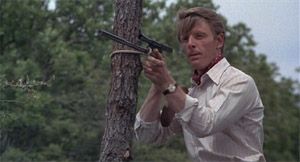
It's a very well crafted film—not showy, but effective, and some of the minute details were really delicious (e.g., his technique for practicing with the rifle, pictured above). It could have been a bit less dry, I suppose, but it simply isn't that kind of film. I enjoyed it as it was.

Wednesday, May 23, 2012

The Magnificent Seven (1960)


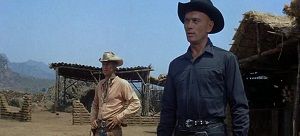
It is probably not fair to say, but this is certainly no Seven Samurai. There are some similarities, though. Aside from the plot, of course, there is the way both films lean heavily on their actors' charisma—and in both cases, there's plenty to lean on. That's probably, in fact, the only thing this one has on its predecessor. Yul Brynner and Steve McQueen, backed by the likes of Eli Wallach, Charles Bronson, and James Coburn? Yeah, personality's not going to be an issue.

For me, though, it wasn't quite enough to support it. The cast exuded cool, in the "not warm" sense of the word. Horst Buchholz' Kikuchiyo Chico is the greatest exception, of course. But honestly, I thought Wallach was the most impressive presence in the film. I have to admit, I wasn't excited at the prospect of watching a Brooklyn Jew play the most significant Mexican character, but I was pleasantly surprised. He didn't strain himself to find authenticity, but did create a complex, rather menacing character. He really felt like the balancing point for the film, and I was glad to see him get more screen time than I remember for his Japanese counterpart.

Review after review of this film describes it as "a lot of fun," or some more masculine equivalent of that. All of which is probably true, if icy cool is your preferred shade of manhood. (For my part, I would rather watch Kelly's Heroes.) Sorry if I spend too much time comparing it to its Japanese predecessor, but honestly, if it didn't have that connection, it would just be another Western. I'm sure I never would have seen it. Still, it's a movie that knows where it's going, and manages to get there.

Thursday, May 17, 2012

The Double Life of Veronique (1991)


If this were the only one of Kieślowski's works I'd seen, I'm sure I'd be quite taken by it. He has a way of tapping into the ephemeral, transitory nature of really important questions, and that's clearly at work here. He beautifully weaves together the mysteries of identity, fate, connection with other human beings—it's a film with a lot to say, and a lot to ask.

In the course of Kieślowski's career, The Double Life of Veronique falls between The Decalogue and the Three Colors trilogy. Unfortunately, I didn't find this film to measure up to either of those series in any important way.

Thematically, Veronique shares plenty of elements with the rest of his oeuvre. That tapestry of questions stretches throughout. But if I imagine the whole thing as a conversation he's having with himself, this film seems more an off-hand remark than a substantive contribution. Take it out, and not much is lost.

Visually, Kieślowski is really never less than a master. He does produce some iconic images here, and in certain moments it's quite poignant. It is never as compelling, though, as his best work. It lacks the raw intimacy of The Decalogue, and the sumptuous immersion of Three Colors. Not that it needs to emulate those other works, any more than they emulate each other. But Veronique simply isn't on the same level. The aesthetic is inconsistent, unfocused, and just when you start to get hooked, it loses its grip.

Other aspects of the film are even less impressive. Irene Jacob is spectacular in Red, but here she hits far too many wrong notes. Granted, she isn't given enough to work with. Weronika, in particular, is a giddy girl in a woman's body, searching in every moment for someone else to lean on. The only times she seems at all in control are when she's singing, and unfortunately those moments are seriously marred by the poor lip syncing. I hate to dwell on what would otherwise be a minor technical detail, but it really is critical here.

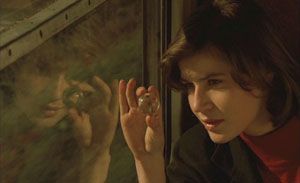
Veronique is more interesting, but still a bit more bland than she needs to be. Part of the problem with the film in general is Kieślowski's (truly uncharacteristic) impatience in pivotal moments. When Veronique discovers the photo from Kraków, for instance, she doesn't dwell on it, she doesn't slowly fade. She simply breaks into sobs. Moments like that give the film a kind of skeletal feel, and I'd certainly like them to be fleshed out.

In a similar way, the film suffers from often far-too-direct dialogue. In all of his films, Kieślowski wants to move obliquely through his subject matter, never facing it full on, and never approaching any kind of blunt moralizing or didacticism. He's far more successful in his other work than he is here, unfortunately. The characters in Veronique keep trying to articulate the film's central themes—that sense of detachment, or of a division within oneself. The thrust of the film is to indicate that this feeling can't really be captured, and yet still they keep talking about it.

All that said, and I mean this sincerely, it's a good film. I'm tempted to view it as a starting point for a brilliant director, notwithstanding The Decalogue and the lengthy career that preceded it. If it wasn't the beginning of Kieślowski's career, still it feels like a beginning of some kind. Perhaps as I see more of his early work, I'll find this to be a significant move in a new direction. Even now, it's not hard for me to see how this led into the Three Colors trilogy. And as I said before, if this were all the Kieślowski I'd ever seen, I'd definitely want to see more.

Saturday, March 17, 2012

Inglourious Basterds (2009)


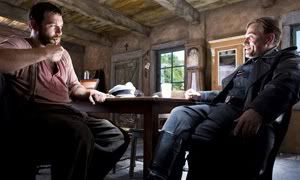
I have to admit, I was ready to give up on Quentin Tarantino. I'm not a fan of capital-d Directors, by and large, because I think they tend to be self-indulgent and/or pretentious. Tarantino is certainly no exception, especially when it comes to indulgence. The last few films I've seen from him—Four Rooms, Jackie Brown, and certainly Kill Bill—have been more than I could take. I find myself watching them thinking, "Man, this guy is full of himself." Which can be a bit distracting if you're actually interested in, you know, watching the movie. So I wasn't even going to bother seeing Inglourious Basterds, but somehow I heard enough good things to end up putting it on my list. Before I sat down to watch it, though, I was prepared for it to be the last Tarantino film I ever bothered with.

I was pleasantly surprised. This film represents most of what I like about QT, and not much of what I don't. He has always had a wonderful way of drawing out a scene, pulling the suspense tight but not letting it break. The opening scene in the cabin was spectacular, and honestly that set me up to enjoy the film from the start. This particular talent is also where he can be a bit indulgent—the tediously long introduction of Eli Roth's otherwise insignificant character, for example. But for the most part, he keeps it well in check, and most of the suspense has a worthy payoff.

Tarantino's immense knowledge of film convention is another talent which can become an indulgence. He loves to make jokes that only film geeks will understand, and rarely do ten full minutes pass without an homage of some kind. Fair enough, as long as it doesn't intrude on  the film. A few times here, though, he does manage to use that level of understanding to actually improve the story. Parallel plot lines that we expect to collide actually end up merging nicely. Characters are introduced and set up as important, only to be abruptly dispensed with. You end up with very little confidence as to who will survive to see the end of the film, and that's a good thing.

So yes, I enjoyed the film. It was well acted, well directed, and quite a bit of fun to watch. I wouldn't have minded seeing it on the big screen, actually, and next time around I might just give QT another chance. We'll see.

Saturday, March 3, 2012

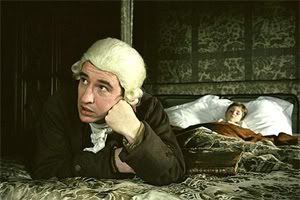
Tristram Shandy: A Cock and Bull Story (2005)


With a movie like this, you either go along for the ride, or you don't. I did. When Steve Coogan teams up with Michael Winterbottom and Rob Brydon, I'm bound to. And while the humor with this group usually has a lot of ups & downs, I didn't ever feel bored during Tristram Shandy. Coogan plays himself playing himself quite well, and his self-deprecation is pitch-perfect.

All the meta levels of the film work quite well. It was particularly fun watching the adult Tristram Shandy introduce, and then critique, the actor playing his childhood self. I also appreciated the various transitions where people slip in and out of character, or where the crew step in and out. That was all handled really well, and made it a lot of fun. In the last half, though, as the film gets more and more tied to the off-screen stuff, it loses some of its vigor.

It was a fun film, but felt a bit slight. When it was all over, I had a lesser version of the same feeling I usually get from PoMo stuff, which is basically the resounding question "Why?" It's easier to find the purpose and meaning behind a Judd Apatow movie, I think, than behind so many of the ironically detached exercises that PostModernists love to love. Still, as I said, that reaction was muted with this movie. Mostly because I did find it so funny, and I think that is mostly down to Coogan's performance.

Thursday, March 1, 2012

Days of Heaven (1978)


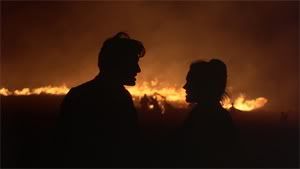
So, I've finally found a Malick film that I'm not wild about. There's plenty to like, and I can certainly see why a lot of people consider it a masterpiece. It's gorgeous, of course—almost every shot is a stunner—and yet that really doesn't detract from the story, which isn't always a given in auteur films. Other technical aspects of the film—the sound especially, and I don't just mean the music—are also quite impressive, and again serve the story well. So far, so good.

But then, there's the actual story. It's certainly pretty standoffish, as far as the emotion goes, but that's so obviously a conscious choice that I have to regard it as disciplined storytelling. The dryness of the telling was certainly in keeping with the film's locale, and the two feed back into each other pretty naturally. So I really didn't mind it. For the most part. I do think, though, that putting Richard Gere in this role was one of the worst casting choices I've ever seen. Especially at this age, Gere is completely incapable of a non-arrogant moment. It's not that he can't display, or even explore, other emotions—sadness, hopelessness, joy, love, envy, or playfulness, for example. It's just that in every one of those moments, his character also seems to be completely full of himself, assured of his own greatness. It doesn't serve this role well. Bill is a character with a lot of brashness, to be sure. It's his driving force, really. But he goes through several significant transformations in the course of the film, and during some of those transitional moments, his self-assuredness doesn't ring at all true. In those moments, the emotional tone of the film doesn't seem dry so much as shallow.

What bothered me much more, though, was the deep misogyny underlying the whole thing. On a second viewing, especially, I was struck by what a slight character Abby really is. If the whole film turns around her, and I think it does, that doesn't mean that she herself is actually important. Rarely does the film, or any one of its characters, ascribe her any real agency. Her fateful decision to go with The Farmer isn't even really her decision, as we're reminded several times. Bill pushes her into it, and she just goes where she's told. Neither does her relationship with The Farmer seem to have any real substance. In a way, she seems to exist simply as an object of desire for both men, and the central conflict of the film is actually just the overlapping of their desires. It's almost homoerotic, frankly. The two men are intimately connected, even though all they really share is a lover.

There's a lot to the film, and I'm certainly glad I watched it (both times). But I didn't come around to it, and I doubt I will try again.

Saturday, July 16, 2011

Seven Samurai (1954)


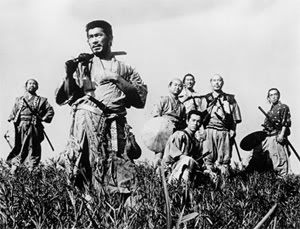
I'm surprised at how much I enjoyed this movie. First of all, not to sound pedestrian, but I'm impressed that a Japanese movie from the '50s was able to keep my interest for 3+ hours, much less to be as fun as it was to watch. Secondly, one of the main characters (Mifune's Kikuchiyo) should have really annoyed the hell out of me, but he didn't. This is a little bit due to some great writing—he's a beautifully complex character—but even more due to Mifune's performance. Believe it or not, this is the first movie I've seen him in. He was really engaging to watch, throughout. I have to say, though, that Takashi Shimura was the actor that really brought me into the film. His charisma reminded me most of John Wayne—just this smoldering presence on screen, who won't allow you to turn away from him.

The film itself was superbly made. It really isn't difficult to spend 3 hours with these characters. The ensemble cast is well filled out, with great roles well performed. At least four of the samurai, as well as quite a few of the villagers, had compelling arcs to follow. The female characters were not so present, unfortunately. Obviously there was a tendency to that, since all of the samurai were men. Shino is a real presence in the film, but it would have been nice to hear more from other peasant women. One or two have moments where you catch a glimpse of a backstory, but they could have been given more time. Obviously I'm not arguing that the film should have been longer, but surely we could have spent less time dwelling (for instance) on the drunken samurai in town who takes their rice and then cowers in his bunk.

I did enjoy the love-story subplot with Shino and Katsushiro. Their discovery of each other was engaging, and their relationship beautifully exemplified the tension between the samurai and the farmers which underlies the entire story. That class tension was the most interesting aspect of the movie, especially as Kurosawa mostly chose to work with it in oblique angles. The final scenes—where the surviving three samurai watch the farmers joyfully going about their work, and we watch Katsushiro struggling with his choice to leave—are the most poignant of the film. (One thing I did love about that, by the way, was that Shino had already made her choice, and she didn't simply cling to him, begging him not to leave. One wonders, if he'd chosen to stay, whether she'd even have let him.)

Aesthetically, Kurosawa is of course a master. I really enjoyed his sense of composition throughout the movie. While not many of the shots are as dramatic as, say, Ran, they have a subtle beauty—and often a subtle significance—that really makes them stand well on their own. And finally, not to drag this review on, but I was really affected by the brief appearance of the flag. There is a lot going on there, touching on elements of nationalism, solidarity, and the power of symbols, which I found myself really thinking about in a new light. It certainly wasn't the most conspicuous symbol in the film (the four swords sticking out from the graves would probably take that honor), but there was a kind of magic that took place in the making and use of that flag that was more than the sum of its actions.

I enjoyed this film even more than I expected to. I responded to Ran largely in that I recognized its significance. Not to say I didn't enjoy it, but that enjoyment was perhaps outweighed by my appreciation of it. Those proportions were reversed for this film. While I did appreciate its significance (e.g., I really want to see The Magnificent Seven now), mostly I enjoyed watching it (and so I really want to see The Magnificent Seven now).

Wednesday, June 22, 2011

Grey Gardens (1975)


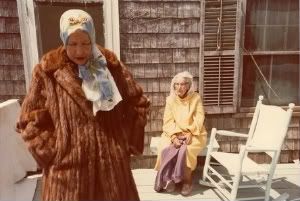
I guess I don't get it. I suffered through this movie, with hardly a moment of respite, constantly trying to see what it is that people like or respect about it, and I didn't come up with anything at all. Reading reviews online afterwards, words like "eccentric" and "unique" keep popping up. I suppose there is my first problem. I've known people like this in real life; I've been in their homes, and there's no charm to that existence. Roger Ebert, in his review, describes the film's two subjects as living "amicably" with raccoons. One can't live amicably with feral raccoons—they carry disease, and their feces are toxic. The same is true for the cat urine that apparently soaks this decaying mansion's floors and carpets (not to put too fine a point on it). Grey Gardens is simply a portrait of two intensely codependent ex-social butterflies, living out the ends of their lives in squalor. I don't know what I was supposed to feel about this, but it can't have been the level of repulsion that I did actually feel.

My second problem was at the personal level. Edith and Edie each have their charms, I suppose—Edie more so than her mother, in my opinion—but neither is nearly enough to carry a feature-length film. And the relationship between the two is just deeply dysfunctional. Not really that unusual or interesting, just thoroughly broken. The film seems to want to dwell in the irony of them pushing away from each other while at the same time clingingly desperately to their shared existence. OK, I guess, but isn't that a pretty run-of-the-mill mother-daughter struggle, even if it's taken to a bit of an extreme?

In the end I found nothing to care about in this movie. I did honestly try, for almost the entire length of it, but there was nothing there for me.

Sunday, June 12, 2011

Ran (1985)


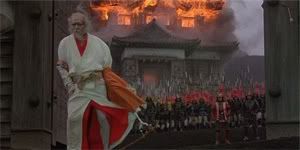
Ran is an engaging tale of human disintegration, at both the levels of the individual and of the family. The setup is perhaps a bit heavy-handed, having Hidetora kill the boar as a way to show us his power, but Kurosawa does complicate it with the old man's show of weakness by falling asleep at the circle afterwards. Saburo is drawn with similar complexity, as are a few of the other roles (Lady Sue comes to mind). But it was the more clearly drawn characters who really drew me into this film. Lady Kaede, Tango, Kurogane, even the scheming Jiro and Taro were more compelling. As an epic, what the film really needed was a driving force, and these characters provided it. In a sense, the complicated character of Hidetora spends the majority of the film simply wandering through the landscape of these clearer minds' making.

The film is masterfully made, progressing steadily from the opening scene to the closing. The former is a display of power—men on horseback atop a grass-covered mountain, in the midst of a boar hunt. The latter is a scene of desolation—a lone blind man, feeling his way back from the perilous edge of a ruined castle wall. Kurosawa paces the story continuously down this trajectory, as both Hidetora and his family fall into ruin. In truly tragic style, the end is always clear. Kyoami, the fool and the film's truth-teller, puts it best when he jokingly tells his lord to "hurry, what with hell so near and heaven so far."

The lingering question of the film is "Why?" What character trait is it that causes Hidetora's world to fall apart? Is it Hidetora's vanity, his impulsiveness? The naked ambition of his sons? The vengeance inspired by his cruelty? I think the answer is that it's all of these things, and in a greater sense, none of them. What the film shows is that his empire is a fragile, complicated structure, held together with little more than his own will and the calcification of custom. When he pulls himself out, like a linchpin, the entire assemblage disintegrates into the Chaos of the film's title.

Friday, June 3, 2011

Elizabethtown (2005)


If I had to describe this movie in one word, that word would be: Bad. Fortunately, I don’t have to, so I can admit that there are some good parts. I can finally see what people like about Cameron Crowe, I think. The best way I can put it is that there’s something comfortable about his movies. You feel yourself just settling into them. With this one I did, anyway.

But I kept getting taken back out of it, in really jarring ways. Kirsten Dunst was fucking horrible in this movie, and I don’t blame her. That was one of the worst-written, most predictable roles ever. It was Hollywood’s version of the Manic Pixie Dream Girl. In every detail, right down to the way she leans in at just the right moment in that last scene (when he finds her at the Farmer’s Market). And the thing is, that role is really typical of the movie as a whole. It was just so unbearably predictable.

Except that with most predictable movies, at least you know what’s coming next. I know that sounds contradictory, but I mean it. This movie was basically a pastiche of really predictable characters and situations—very poorly executed, I might add—interspersed with these unbelievable digressions out into nowhere. The train really went off the rails at the wake. Everything about that was just, wow, just really shockingly bad. [I might add, as a bit of an aside, that Crowe’s characters are really unlikeable. Could they possibly be any more self-obsessed? And the more central the character, the worse they are.] OK: What. The Hell. Were all those people laughing and clapping for when Susan Sarandon was on stage? Was I hallucinating, or did she finish off with a tap-dance number (and then, of course, to truly sell the cliché, did she look at the huge picture of Mitch and mouth the words, “I love you”)? Was that a stand-up–comedy routine she was doing? I must have passed out at some point, because I missed the part where that was in any way relevant to the man they were all there to grieve.

I’m being serious, by the way—I think I passed out at some point. This movie was like a twelve-pound sledge to the frontal lobe. I can barely see straight. The only saving grace, I guess, was that after the wake the movie officially transcended into So-Bad-It’s-Good status. Or at least So-Bad-It’s-Hilarious.

Wow. Just wow wow wow. A lot of people took a lot of drugs to make this movie happen, obviously. And just as with any drug-induced fiasco, I don’t know whether to thank them for the laughs, or just try to move on with my life and pretend the whole sordid thing never even happened. I think I can feel myself starting to repress it, even now.

Wednesday, June 1, 2011

Badlands (1973)


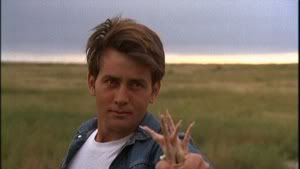
If nothing else, Terrence Malick is a patient filmmaker. He is content to simply spend time with his characters, letting them develop organically rather than putting them through a series of dramatic plot points which can define them clearly. This film develops at its own pace. We watch as Kit spends the morning dumping trash for the city, noticing little details about the people and places along his route and joking around with his co-worker. There's a bit more drama in Holly's narration, but it's muted simply by virtue of being narration, and of course through Spacek's deadpan intonation of it. Though there are moments of foreboding and drama, just as often there are significant moments which pass by almost undetected. The first time we see Kit's gun, for example, it's just there in his pocket as he's moving around Holly's room. This patient, hyper-realist style is an interesting choice, and it has the effect of bringing down to ground level what would otherwise be a larger-than-life story.

The ancillary effect of the style is that it lays the burden of the story directly onto those in front of the camera. It's a great choice, though—if Martin Sheen and Sissy Spacek can't carry your film, it can't be carried. They each fill out their characters wonderfully. Sheen is a charismatic presence immediately. On the page, his character is not so much quirky as deranged, but Sheen manages to lend an air of intrigue to Kit, and to weave his meandering thoughts into a mostly fluid line. For her part, Spacek develops an admittedly personality-free girl into a willful, moral presence.

I had expected this to be a much more somber film, but Malick is playful—most obviously with the music, but also with the irony in Holly's telling of the story, and with the interactions between this pair and the strangers they meet. It's an offbeat film, and an infectious one.

Sunday, May 29, 2011

Raiders of the Lost Ark (1981)


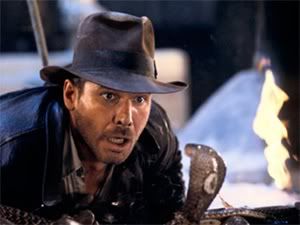
Yeah, this movie's crap. I didn't really expect to like it, but I was hoping it might surprise me. It didn't. A series of over-the-top (in a not-really-good way) adventures which plod along driven primarily by stupid decisions on the part of the protagonist or one of his many nemeses, it mostly failed to elicit any reaction from me at all. The action sequences were comical, like the rest of the movie. I wasn't thrilled by them, I felt nothing for any of the characters, and any time I started to actually care about the purported goal (the ark itself), I got so distracted by the terrible dialog and hammy acting that my concern entirely evaporated. This movie was, as they say, a mile wide and an inch deep. When one of the main characters supposedly dies in the middle of the movie, I couldn't have cared less (and not just because I knew it wasn't real, and the filmmakers would use some flimsy excuse to bring her right back as soon as they felt like it). When the ark is taken away from our heroes only moments after they've recovered it, I couldn't have cared less. And again, not just because I knew that the filmmakers wouldn't even bother straining themselves in coming up with a way for Indy to steal it back. True crises require a bit of trust, and I had none for this film. True suspense requires patience, and Spielberg shows no capacity for that here.

Certainly there are people who like camp more than I do, but I completely fail to see the allure. Making compelling, interesting movies is hard, and purposefully not even trying is a cop-out. Even if you disagree on that, though, what do you get from this kind of movie? Contrary to what seems to be universal opinion, it's not very well made—either technically or narratively. And it's not witty enough to be at all ironic, so what is there to engage with? What's to like? For my part, I didn't find much.