Showing posts with label 1970s. Show all posts

Friday, August 31, 2012

Animals Are Beautiful People (1974)


If you've never seen The Gods Must Be Crazy, this movie will probably be pretty surprising. If you have seen it, this should still be awfully entertaining. Animals Are Beautiful People is offered more as a straightforward documentary than is its obviously-fictional descendant, and that pretense makes a beautiful stage on which to present this parody. Filmmaker Jamie Uyr treads the line carefully, and manages a nearly pitch-perfect comedic documentary (a rare genre indeed, and certainly not to be confused with the more familiar mockumentary).

Actors, directors, and writers have long argued that comedy is much harder than it looks, and specifically that it requires real commitment if you're going to pull it off. This is Uyr's strongest asset. He does have some great footage of the animals & plants which populate the deserts of southern Africa. The film is rife with can-you-believe-it facts, just as any nature documentary would be, and most of them seem to be true. This is, at its core, a nature documentary. A careful observer may notice some liberties in the editing, and elsewhere, but they are infrequent and subtle enough to be harmless. And they do serve the tone of the film well.

It's that tone that sets the film apart. Certainly no straightforward documentary would describe its subjects with the casual, judgmental, and even mocking lines that fill out most of the narration here. It comes on gradually, though, and Paddy O'Byrne speaks with just the right amount of irony to sell it but not oversell it.

It's a well balanced film, with plenty of levity punctuated by serious—even grave—moments, and humor laid casually over a documentary's worth of interesting factual information. Mostly, it's just surprisingly fun to watch. I'm sure I'll be watching it again soon (with the kids), and I'm hopeful it will hold up well.

Thursday, August 9, 2012

The California Kid (1974)


This is a made-for-TV movie, and it shows, especially in the production values and the music (more about the latter in a minute). I certainly wouldn't have watched it if it hadn't been freely available on YouTube. That said, it was a lot of fun, and the characters were surprisingly interesting (relative to other TV movies, of course).

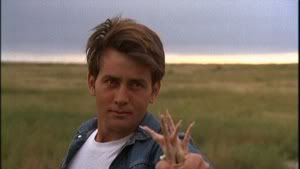
The biggest draw, apart from the free-ness, is the star. Martin Sheen is the eponymous lead, and brings a boatload of charisma to a character who offers (and needs) nothing else. Nick Nolte shows up in a small but significant part, and hits the pitch perfectly. TV-movie star Vic Morrow could probably have done a bit more with the troubled, possibly-evil antagonist, but that is certainly asking too much from a made-for-TV flick. It would have been pretty disturbing if he'd gone any further with it, honestly.

It's a terse, tautly drawn drama, and if it doesn't do a lot to pull you in, it also doesn't give you much time for distraction. The action runs along fairly quickly, toward a pretty predictable end, but with a few interesting moments along the way.

And now a note about the music. The film is supposed to take place in the late 50s, but the music is pure 70s. And it's one of the best things about this film. It's so out of place that it pretty much takes over, and sets the entire mood. If you're not carried away by the wikkity-wah-wah of the opening credits, don't bother watching any further. Music is the raft that will carry you down this river, and if you can stay on board, it's a fun ride.

Thursday, July 26, 2012

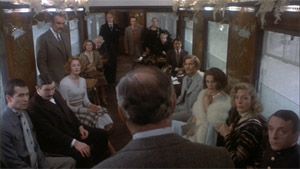
Murder on the Orient Express (1974)


If this film is evidence of anything, it's that a collaboration among the best & brightest doesn't always produce the greatest result. Story by Agatha Christie. Directed by Sidney Lumet. An all-star cast, including Albert Finney, Lauren Bacall, Ingrid Bergman, Sean Connery, John Gielgud, Anthony Perkins, Vanessa Redgrave, and Richard Widmark. This thing can't fail.

And it doesn't, exactly, but it really doesn't succeed either. There are a few of the standard Poirot lines ("What a funny little man", "You're Belgian? I'd thought you were French."), but no real wit. Nothing popped; the movie just plods along through a fairly routine (and largely telegraphed) whodunit. From that entire cast of stars, there's not a single noteworthy performance. The best thing you can say is that some of them managed to really disappear into their roles (Finney & Bergman, especially). But what a movie like this wants is some sparkle, some charm. Only Perkins, of all people, brings any of that, and it's certainly not enough to go around.

And finally, I have to mention the two lengthy scenes near the end—the re-enactment of the deed, and the champagne toasts. Both were given entirely too much time and attention. I can't say much more without a spoiler, but they really drew out the end of an already too-long film, and to no positive effect.

Thursday, May 31, 2012

The Day of the Jackal (1973)


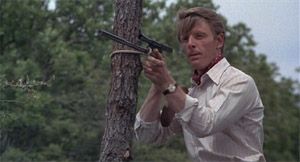
For a hitman thriller, there's remarkably little action in this film. The pacing seemed a bit slow as it went on, but only afterward did I realize how successful it had been at maintaining tension throughout the 2-hour–plus runtime. Through the first half or so it focuses almost entirely on our protagonist's methodical preparations for the act. Edward Fox carries us through this handily, his air of quiet nerve a prototype for characters in the genre. He turns this into a wonderfully sympathetic character. I don't want to say that I managed to forget he was a hitman, but actually it was more like I forgot what makes a hitman a hitman. So the first time Fox kills someone, I actually gasped. I saw it coming, I suppose, and yet the performance of it was very much an icy-cold shot of water in the face.

As this lone-actor story begins to blend with the detective story that's been building on the other end, things get considerably more interesting. The most intriguing performance of the film—and my favorite character overall—is Michael Lonsdale as Lebel. His dogged, intelligent determination is beautifully counterpointed by his quiet, controlled demeanor, and together with Derek Jacobi's supporting role, the investigation quickly becomes the driving force of the film. The tension becomes outright suspense, and carries the film through to its climax—which is a bit rushed and a bit incredible, but not enough to really hurt the film. Even if it had, the coda that follows is rich enough to revive it.

It's a very well crafted film—not showy, but effective, and some of the minute details were really delicious (e.g., his technique for practicing with the rifle, pictured above). It could have been a bit less dry, I suppose, but it simply isn't that kind of film. I enjoyed it as it was.

Thursday, March 1, 2012

Days of Heaven (1978)


So, I've finally found a Malick film that I'm not wild about. There's plenty to like, and I can certainly see why a lot of people consider it a masterpiece. It's gorgeous, of course—almost every shot is a stunner—and yet that really doesn't detract from the story, which isn't always a given in auteur films. Other technical aspects of the film—the sound especially, and I don't just mean the music—are also quite impressive, and again serve the story well. So far, so good.

But then, there's the actual story. It's certainly pretty standoffish, as far as the emotion goes, but that's so obviously a conscious choice that I have to regard it as disciplined storytelling. The dryness of the telling was certainly in keeping with the film's locale, and the two feed back into each other pretty naturally. So I really didn't mind it. For the most part. I do think, though, that putting Richard Gere in this role was one of the worst casting choices I've ever seen. Especially at this age, Gere is completely incapable of a non-arrogant moment. It's not that he can't display, or even explore, other emotions—sadness, hopelessness, joy, love, envy, or playfulness, for example. It's just that in every one of those moments, his character also seems to be completely full of himself, assured of his own greatness. It doesn't serve this role well. Bill is a character with a lot of brashness, to be sure. It's his driving force, really. But he goes through several significant transformations in the course of the film, and during some of those transitional moments, his self-assuredness doesn't ring at all true. In those moments, the emotional tone of the film doesn't seem dry so much as shallow.

What bothered me much more, though, was the deep misogyny underlying the whole thing. On a second viewing, especially, I was struck by what a slight character Abby really is. If the whole film turns around her, and I think it does, that doesn't mean that she herself is actually important. Rarely does the film, or any one of its characters, ascribe her any real agency. Her fateful decision to go with The Farmer isn't even really her decision, as we're reminded several times. Bill pushes her into it, and she just goes where she's told. Neither does her relationship with The Farmer seem to have any real substance. In a way, she seems to exist simply as an object of desire for both men, and the central conflict of the film is actually just the overlapping of their desires. It's almost homoerotic, frankly. The two men are intimately connected, even though all they really share is a lover.

There's a lot to the film, and I'm certainly glad I watched it (both times). But I didn't come around to it, and I doubt I will try again.

Wednesday, June 22, 2011

Grey Gardens (1975)


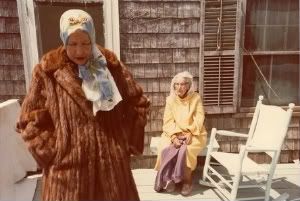
I guess I don't get it. I suffered through this movie, with hardly a moment of respite, constantly trying to see what it is that people like or respect about it, and I didn't come up with anything at all. Reading reviews online afterwards, words like "eccentric" and "unique" keep popping up. I suppose there is my first problem. I've known people like this in real life; I've been in their homes, and there's no charm to that existence. Roger Ebert, in his review, describes the film's two subjects as living "amicably" with raccoons. One can't live amicably with feral raccoons—they carry disease, and their feces are toxic. The same is true for the cat urine that apparently soaks this decaying mansion's floors and carpets (not to put too fine a point on it). Grey Gardens is simply a portrait of two intensely codependent ex-social butterflies, living out the ends of their lives in squalor. I don't know what I was supposed to feel about this, but it can't have been the level of repulsion that I did actually feel.

My second problem was at the personal level. Edith and Edie each have their charms, I suppose—Edie more so than her mother, in my opinion—but neither is nearly enough to carry a feature-length film. And the relationship between the two is just deeply dysfunctional. Not really that unusual or interesting, just thoroughly broken. The film seems to want to dwell in the irony of them pushing away from each other while at the same time clingingly desperately to their shared existence. OK, I guess, but isn't that a pretty run-of-the-mill mother-daughter struggle, even if it's taken to a bit of an extreme?

In the end I found nothing to care about in this movie. I did honestly try, for almost the entire length of it, but there was nothing there for me.

Wednesday, June 1, 2011

Badlands (1973)


If nothing else, Terrence Malick is a patient filmmaker. He is content to simply spend time with his characters, letting them develop organically rather than putting them through a series of dramatic plot points which can define them clearly. This film develops at its own pace. We watch as Kit spends the morning dumping trash for the city, noticing little details about the people and places along his route and joking around with his co-worker. There's a bit more drama in Holly's narration, but it's muted simply by virtue of being narration, and of course through Spacek's deadpan intonation of it. Though there are moments of foreboding and drama, just as often there are significant moments which pass by almost undetected. The first time we see Kit's gun, for example, it's just there in his pocket as he's moving around Holly's room. This patient, hyper-realist style is an interesting choice, and it has the effect of bringing down to ground level what would otherwise be a larger-than-life story.

The ancillary effect of the style is that it lays the burden of the story directly onto those in front of the camera. It's a great choice, though—if Martin Sheen and Sissy Spacek can't carry your film, it can't be carried. They each fill out their characters wonderfully. Sheen is a charismatic presence immediately. On the page, his character is not so much quirky as deranged, but Sheen manages to lend an air of intrigue to Kit, and to weave his meandering thoughts into a mostly fluid line. For her part, Spacek develops an admittedly personality-free girl into a willful, moral presence.

I had expected this to be a much more somber film, but Malick is playful—most obviously with the music, but also with the irony in Holly's telling of the story, and with the interactions between this pair and the strangers they meet. It's an offbeat film, and an infectious one.

Sunday, May 22, 2011

Annie Hall (1977)


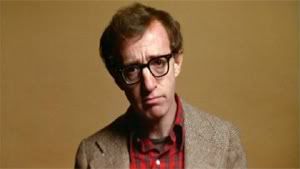
I should probably start by saying that I can see what's great about this movie. Especially for its time, and for its genre, it took a lot of risks, and most of them worked out great. Allen breaks all kinds of ground, with both technical and narrative aspects—breaking the 4th wall, non-linear chronology, the novel use of split screens, etc. And truly, almost every one of those things makes this a better movie. I'm not a person who gives credit for experimentation propter se. I want it to actually work, and I want it to serve the story. Most of those techniques do both, and I appreciated Allen's diligence in that regard.

In the end, though, the movie didn't come very close to winning me over. Firstly, I was not at all attached to the two leads. (Or to any of the characters, come to think of it.) Obviously Allen's character is autobiographical to some degree, which didn't actually help. Alvy strikes me as an incredibly shallow character. Ebert describes him as someone who "lives in order to talk about living," and I think that's a great point. He's compulsively disengaged from the world, and seems to have no real drive as a character. Compulsion is a poor substitute. Annie is also not terribly interesting. Obviously Allen sets her up as a foil from the beginning, as he typically does with female characters. She exists to make Alvy seem sophisticated and wise, which she accomplishes by being a wide-eyed rube. I guess I can see what Alvy is supposed to fall in love with, but I myself certainly didn't take the fall.

Perhaps the worse problem, though, is that I didn't find the movie funny. Most of the humor comes off as simple glibness, which again, I think is a poor substitute. It was fitting with the characters, but it wasn't enough to fill out the film. There were a few moments that were genuinely funny, but I would have enjoyed them more if I'd been at all warmed up for them.

I didn't hate Annie Hall; it certainly earned all three of those stars. But it solidified my position: I won't be seeing Hannah and Her Sisters, Manhattan, or any other Woody Allen movies. Crimes and Misdemeanors is still one of my all-time favorites, and I've seen other of his films that I've enjoyed to varying degrees. But I don't think he has anything more to offer me, really. I'm not breaking any new ground, I know, in pointing out that he's cynical and mysogynistic. But he is, and his more positive qualities no longer outweigh it for me.