Showing posts with label akira kurosawa. Show all posts

Saturday, July 16, 2011

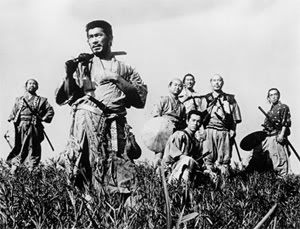
Seven Samurai (1954)


I'm surprised at how much I enjoyed this movie. First of all, not to sound pedestrian, but I'm impressed that a Japanese movie from the '50s was able to keep my interest for 3+ hours, much less to be as fun as it was to watch. Secondly, one of the main characters (Mifune's Kikuchiyo) should have really annoyed the hell out of me, but he didn't. This is a little bit due to some great writing—he's a beautifully complex character—but even more due to Mifune's performance. Believe it or not, this is the first movie I've seen him in. He was really engaging to watch, throughout. I have to say, though, that Takashi Shimura was the actor that really brought me into the film. His charisma reminded me most of John Wayne—just this smoldering presence on screen, who won't allow you to turn away from him.

The film itself was superbly made. It really isn't difficult to spend 3 hours with these characters. The ensemble cast is well filled out, with great roles well performed. At least four of the samurai, as well as quite a few of the villagers, had compelling arcs to follow. The female characters were not so present, unfortunately. Obviously there was a tendency to that, since all of the samurai were men. Shino is a real presence in the film, but it would have been nice to hear more from other peasant women. One or two have moments where you catch a glimpse of a backstory, but they could have been given more time. Obviously I'm not arguing that the film should have been longer, but surely we could have spent less time dwelling (for instance) on the drunken samurai in town who takes their rice and then cowers in his bunk.

I did enjoy the love-story subplot with Shino and Katsushiro. Their discovery of each other was engaging, and their relationship beautifully exemplified the tension between the samurai and the farmers which underlies the entire story. That class tension was the most interesting aspect of the movie, especially as Kurosawa mostly chose to work with it in oblique angles. The final scenes—where the surviving three samurai watch the farmers joyfully going about their work, and we watch Katsushiro struggling with his choice to leave—are the most poignant of the film. (One thing I did love about that, by the way, was that Shino had already made her choice, and she didn't simply cling to him, begging him not to leave. One wonders, if he'd chosen to stay, whether she'd even have let him.)

Aesthetically, Kurosawa is of course a master. I really enjoyed his sense of composition throughout the movie. While not many of the shots are as dramatic as, say, Ran, they have a subtle beauty—and often a subtle significance—that really makes them stand well on their own. And finally, not to drag this review on, but I was really affected by the brief appearance of the flag. There is a lot going on there, touching on elements of nationalism, solidarity, and the power of symbols, which I found myself really thinking about in a new light. It certainly wasn't the most conspicuous symbol in the film (the four swords sticking out from the graves would probably take that honor), but there was a kind of magic that took place in the making and use of that flag that was more than the sum of its actions.

I enjoyed this film even more than I expected to. I responded to Ran largely in that I recognized its significance. Not to say I didn't enjoy it, but that enjoyment was perhaps outweighed by my appreciation of it. Those proportions were reversed for this film. While I did appreciate its significance (e.g., I really want to see The Magnificent Seven now), mostly I enjoyed watching it (and so I really want to see The Magnificent Seven now).

Sunday, June 12, 2011

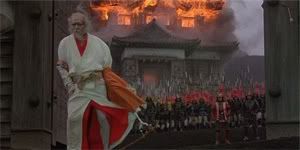
Ran (1985)


Ran is an engaging tale of human disintegration, at both the levels of the individual and of the family. The setup is perhaps a bit heavy-handed, having Hidetora kill the boar as a way to show us his power, but Kurosawa does complicate it with the old man's show of weakness by falling asleep at the circle afterwards. Saburo is drawn with similar complexity, as are a few of the other roles (Lady Sue comes to mind). But it was the more clearly drawn characters who really drew me into this film. Lady Kaede, Tango, Kurogane, even the scheming Jiro and Taro were more compelling. As an epic, what the film really needed was a driving force, and these characters provided it. In a sense, the complicated character of Hidetora spends the majority of the film simply wandering through the landscape of these clearer minds' making.

The film is masterfully made, progressing steadily from the opening scene to the closing. The former is a display of power—men on horseback atop a grass-covered mountain, in the midst of a boar hunt. The latter is a scene of desolation—a lone blind man, feeling his way back from the perilous edge of a ruined castle wall. Kurosawa paces the story continuously down this trajectory, as both Hidetora and his family fall into ruin. In truly tragic style, the end is always clear. Kyoami, the fool and the film's truth-teller, puts it best when he jokingly tells his lord to "hurry, what with hell so near and heaven so far."

The lingering question of the film is "Why?" What character trait is it that causes Hidetora's world to fall apart? Is it Hidetora's vanity, his impulsiveness? The naked ambition of his sons? The vengeance inspired by his cruelty? I think the answer is that it's all of these things, and in a greater sense, none of them. What the film shows is that his empire is a fragile, complicated structure, held together with little more than his own will and the calcification of custom. When he pulls himself out, like a linchpin, the entire assemblage disintegrates into the Chaos of the film's title.