Showing posts with label 1950s. Show all posts

Thursday, June 21, 2012

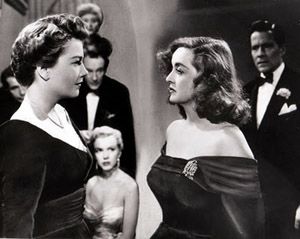
All about Eve (1950)


I had several problems with this film, but let me start with a few of the more minor. First of all, the characters seem more like...well, more like characters than actual human beings. There is very little depth or complexity to anyone—provided one doesn't confuse flakiness with complexity, but more on that in a minute. (The one exception is Thelma Ritter, who of course has more natural charisma and substance in her lower lip than most actors have in their entire body.) It's not just that people seem stiff, although for the most part they do. It's more than there seems to be nothing unseen, nothing that isn't there to fill out a generic character type or propel the plot.

Speaking of which, back to the question of flakiness vs. complexity. I'm all for inconsistency in a character's actions, so long as it seems to come from some depth or internal contradiction. That's the essence of drama, but it's not what's happening here. When the plot needs Margo to turn on Eve, she simply does so—there is very little evidence of any internal struggle. Karen Richards follows the exact same hairpin arc when it's her turn to further the storyline, and with only slightly more sense that something's at stake. The men, of course, are just so many set pieces, serving the same purpose that women tend to serve in a more traditionally misogynistic film—they exist to prove something about the characters of the opposite sex, or about gender relations at large, rather than to be identifiable personalities in their own right.

Not that the film is any less misogynistic for it, of course. Two of the three female leads are flakes, and the other—Eve herself—is a cardboard cutout. We're never given much of a clue as to her motivation, probably because even the filmmakers didn't think it would be very interesting. She's an ambitious ingenue, who will step on anyone in order to get up a rung. That's all the treatment she gets, but surely even she could have been much more intriguing. Her most captivating moment is indeed when she flashes her vicious side in the one-on-one with Karen, but why couldn't we at least have more of that? She plods through most of them film so robotically that it seems she has no drive at all.

Which brings me to yet another issue. The film is, of course, 'about' gender issues. In show business specifically, but in society in general. But at least as interesting a subject, especially given the question of Eve's motivation, would have been the issue of class. Which is thoroughly—systematically, even—avoided. Even as Addison DeWitt compares himself to Eve while simultaneously claiming to 'own' her, we're never given to ask why—why would one such person end up with all the power, while the other ends up trapped even in her own success? It's a bit to do with gender, yes, but as he himself lays out the case, it's obvious: the real issue is that her name is Gertrude Slojinski, while his is Addison DeWitt. She has had to fight and scrape her way up, while he has simply waited for her at the top. Eve's greatest sin isn't being a woman. It's being a climber.

And finally, if I can return to more minor complaints, the film is just so dry. Some films do well with a lot of dialogue, but this isn't one. Primarily because it isn't dialogue, so much as exposition and real-time analysis by the characters themselves. It could have been 45 minutes shorter, and an awful lot tighter, if they had just shut the hell up once in a while and let things happen.

In spite of these complaints, it's not a terrible film. There are moments of good acting, especially from George Sanders and the aforementioned Thelma Ritter. And there is a worthwhile, interesting story hidden in there somewhere, even if it's obscured by a lot of talking about it and looking in the wrong direction most of the time. This is one film that I'd love to see redone, especially with an eye to more tension and suspense.

Sunday, June 17, 2012

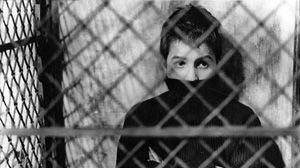
The 400 Blows (1959)


This film is like a smoldering fire, that never flares very high, but steadily, inevitably consumes its protagonist. Jean-Pierre Léaud does an amazing job in the lead role, setting the temperature of the entire film with his stoicism and reserve. He is in virtually every frame, which is a bit ironic since so much of what happens depends on everyone but him. The result is a claustrophobic sense of powerlessness. The audience is never given a way (or a reason) to identify with Antoine's parents or teachers; the world is simply there, at every turn cruel to varying degrees, but without any definitive reason why.

The whole of the film is masterfully designed and executed. Its boundaries are narrowly drawn, and within them it seems entirely complete. Truffaut's work is solid, plain, and immersive. Léaud's performance is well supported by those around him, especially his friend René, who is really the agent of Antoine's downfall, but without any malice or false intent. The contrast between the two is a subtle but illuminating study in what it takes to get ahead in the world.

Really, fire is the wrong metaphor for this film. Antoine isn't so much consumed as he is trapped. The movie's events unfold like a game of chess, and try though he might, he can't avoid that end. Still he never seems desperate, or for the most part even unhappy. The one exception—and certainly the most powerful moment in the movie—is his ride to the Observation Center (which parallels the marvelous opening-credits sequence). Léaud is in full control here, as we see the weight of misfortune settle heavily onto Antoine's shoulders. Still, he's soon back to his stoic self. In the end, though he has no clear path to a better life, as he stands on that seashore he does seem to have a glimmer of hope in his eyes. Here, as throughout the movie, one can't help but feel it with him.

Saturday, July 16, 2011

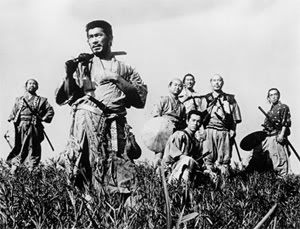
Seven Samurai (1954)


I'm surprised at how much I enjoyed this movie. First of all, not to sound pedestrian, but I'm impressed that a Japanese movie from the '50s was able to keep my interest for 3+ hours, much less to be as fun as it was to watch. Secondly, one of the main characters (Mifune's Kikuchiyo) should have really annoyed the hell out of me, but he didn't. This is a little bit due to some great writing—he's a beautifully complex character—but even more due to Mifune's performance. Believe it or not, this is the first movie I've seen him in. He was really engaging to watch, throughout. I have to say, though, that Takashi Shimura was the actor that really brought me into the film. His charisma reminded me most of John Wayne—just this smoldering presence on screen, who won't allow you to turn away from him.

The film itself was superbly made. It really isn't difficult to spend 3 hours with these characters. The ensemble cast is well filled out, with great roles well performed. At least four of the samurai, as well as quite a few of the villagers, had compelling arcs to follow. The female characters were not so present, unfortunately. Obviously there was a tendency to that, since all of the samurai were men. Shino is a real presence in the film, but it would have been nice to hear more from other peasant women. One or two have moments where you catch a glimpse of a backstory, but they could have been given more time. Obviously I'm not arguing that the film should have been longer, but surely we could have spent less time dwelling (for instance) on the drunken samurai in town who takes their rice and then cowers in his bunk.

I did enjoy the love-story subplot with Shino and Katsushiro. Their discovery of each other was engaging, and their relationship beautifully exemplified the tension between the samurai and the farmers which underlies the entire story. That class tension was the most interesting aspect of the movie, especially as Kurosawa mostly chose to work with it in oblique angles. The final scenes—where the surviving three samurai watch the farmers joyfully going about their work, and we watch Katsushiro struggling with his choice to leave—are the most poignant of the film. (One thing I did love about that, by the way, was that Shino had already made her choice, and she didn't simply cling to him, begging him not to leave. One wonders, if he'd chosen to stay, whether she'd even have let him.)

Aesthetically, Kurosawa is of course a master. I really enjoyed his sense of composition throughout the movie. While not many of the shots are as dramatic as, say, Ran, they have a subtle beauty—and often a subtle significance—that really makes them stand well on their own. And finally, not to drag this review on, but I was really affected by the brief appearance of the flag. There is a lot going on there, touching on elements of nationalism, solidarity, and the power of symbols, which I found myself really thinking about in a new light. It certainly wasn't the most conspicuous symbol in the film (the four swords sticking out from the graves would probably take that honor), but there was a kind of magic that took place in the making and use of that flag that was more than the sum of its actions.

I enjoyed this film even more than I expected to. I responded to Ran largely in that I recognized its significance. Not to say I didn't enjoy it, but that enjoyment was perhaps outweighed by my appreciation of it. Those proportions were reversed for this film. While I did appreciate its significance (e.g., I really want to see The Magnificent Seven now), mostly I enjoyed watching it (and so I really want to see The Magnificent Seven now).