Thursday, May 26, 2011

Bicycle Thieves (1948)


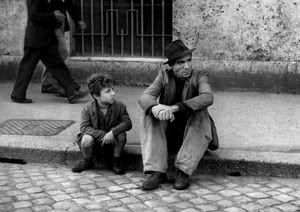
Another film filled with iconic imagery, though certainly not in as stylish a way as M. Really, as I think about it, it's more full of iconic scenes, as opposed to just images. I think that's telling, because the primary quality of this film is the way it pulls you down into the story. It's shot and edited very plainly, so that the content itself does the heavy lifting. Not to say that it's a documentary style—it very much feels like a narrative, with scenes leading one into the other, tension crescendoing and falling. But it stays close to the ground, deeply connected to the immediate reality of what's happening.

The integrity of such a portrayal really draws you in. It's probably most evident when we see the picture of Rita Hayworth. It was a bit heavy-handed, of course, but still not wrong—there's a drastic contrast between the life of a Hollywood star (on- or off-screen) and the lives of these people. In a word, Hayworth seems unreal. By contrast, Antonio seems all the more real.

The most spectacular thing about the film, though, might well be Bruno. Really the entire film turns on this one character, and Enzo Staiola does a fabulous job with the role. He provides a moral and emotional anchor for the film, from the moment he appears. And of course, that gradual development is crucial to the film's final passages.

Sunday, May 22, 2011

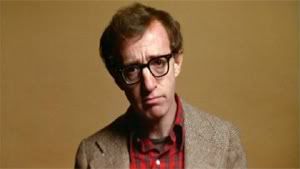
Annie Hall (1977)


I should probably start by saying that I can see what's great about this movie. Especially for its time, and for its genre, it took a lot of risks, and most of them worked out great. Allen breaks all kinds of ground, with both technical and narrative aspects—breaking the 4th wall, non-linear chronology, the novel use of split screens, etc. And truly, almost every one of those things makes this a better movie. I'm not a person who gives credit for experimentation propter se. I want it to actually work, and I want it to serve the story. Most of those techniques do both, and I appreciated Allen's diligence in that regard.

In the end, though, the movie didn't come very close to winning me over. Firstly, I was not at all attached to the two leads. (Or to any of the characters, come to think of it.) Obviously Allen's character is autobiographical to some degree, which didn't actually help. Alvy strikes me as an incredibly shallow character. Ebert describes him as someone who "lives in order to talk about living," and I think that's a great point. He's compulsively disengaged from the world, and seems to have no real drive as a character. Compulsion is a poor substitute. Annie is also not terribly interesting. Obviously Allen sets her up as a foil from the beginning, as he typically does with female characters. She exists to make Alvy seem sophisticated and wise, which she accomplishes by being a wide-eyed rube. I guess I can see what Alvy is supposed to fall in love with, but I myself certainly didn't take the fall.

Perhaps the worse problem, though, is that I didn't find the movie funny. Most of the humor comes off as simple glibness, which again, I think is a poor substitute. It was fitting with the characters, but it wasn't enough to fill out the film. There were a few moments that were genuinely funny, but I would have enjoyed them more if I'd been at all warmed up for them.

I didn't hate Annie Hall; it certainly earned all three of those stars. But it solidified my position: I won't be seeing Hannah and Her Sisters, Manhattan, or any other Woody Allen movies. Crimes and Misdemeanors is still one of my all-time favorites, and I've seen other of his films that I've enjoyed to varying degrees. But I don't think he has anything more to offer me, really. I'm not breaking any new ground, I know, in pointing out that he's cynical and mysogynistic. But he is, and his more positive qualities no longer outweigh it for me.

Friday, May 20, 2011

Fleet Foxes — Helplessness Blues (2011)

There is a rich tradition of musicians, in response to sudden success, reacting with violent opposition to the prospect. Think Nirvana or, more recently, M.I.A.—making music which goes drastically against their newfound fans' expectations, challenging them to prove their devotion. There is an equally rich tradition of artists losing themselves to their own whims, convinced that every inspiration they have is critically important, and trying dutifully to transmit them all to the world at large. Think Guns 'N' Roses, Smashing Pumpkins, or U2. Upon first listening to Helplessness Blues, I assumed it was the former. What other explanation for the decision to begin such an eagerly awaited album with such a thoroughly mediocre song? It might also explain that saxophone breaking in and destroying "The Shrine/An Argument", an otherwise beautiful tune. On the other hand, song titles with slashes in them are an easy indicator that a band has gone the other way, and there are two such songs here. Then too, Pecknold's lyrics are clumsily pretentious more often than they have been on previous releases. In the title track, for instance:
I was raised up believing
I was somehow unique
Like a snowflake distinct among snowflakes
Unique in each way you can see

And now after some thinking
I'd say I'd rather be
A functioning cog in some great machinery
Serving something beyond me
Aside from the triteness of the sentiment itself, we see here a songwriter who can't be bothered with artifices like poetry or challenges like the creation of new metaphors. These are the opening verses of the title track, and the production is such that nothing obscures these lyrics. So it turns out that Fleet Foxes are in that second group of musicians. They may alienate all their fans along the way, but what they're really trying to do is let the world see how important they are.

In spite of all that, it's not a bad album. A few of these indulgences do pay off—"The Plains/Bitter Dancer", in particular. The songs blend together at first, but with repeated listens the cream begins to rise. Certainly they are all an improvement over that middling opener, "Montezuma". Still, the dynamism of their previous work is missing. The scene changes in those slash-titled songs just aren't as compelling as they were in "Mykonos" and "Ragged Wood", and nowhere is there the intrigue of "White Winter Hymnal". If I might grant a back-handed compliment, I would say these songs are better than adequate. The harmonies are familiar and the melodies comfortable, and if Fleet Foxes don't find a lot of new ground this time around, it is still a pleasant space to spend a bit more time in.

Friday, May 13, 2011

Thao & Mirah (2011)

There are any number of adjectives one could apply to Thao & Mirah, but "constrained" would never be one of them. It may not be the throw-everything-against-the-wall aesthetic employed by producer Merrill Garbus on her latest tUnE-yArDs release, but Thao & Mirah certainly are not restricted by any arbitrary boundaries. This album is a great example of just how to make such an approach work—and really work.

The album starts off, with "Eleven", as fairly straightforward blare-pop, like a slightly more tuneful Sleigh Bells. But the song provides a foundation of kinetic energy that is maintained throughout the album as a whole. It's a bit ironic that this album is credited only to Thao & Mirah, because the hand of the producer shows through at almost every turn. Instruments, vocals, sounds, and effects are layered and juxtaposed, continuously moving toward and against each other. But in Garbus' adept hands, these elements coalesce into a structure, rather than just wildly crashing into each other like shoes in a clothes dryer.

This is not to say that the whole album has that lo-fi, distortion-laden sound. The very next song is built on a brief, almost cutesy little guitar riff. But even here, the song really opens up through the second verse, as multiple instruments begin to appear. In the end, again, we find that we've been lured into a structure of sounds piled atop each other, gradually built on that simple beginning. A song like "Little Cup", meanwhile, goes the other way. A collection of slight spare sounds—a few whispered syllabled, some light taps, a very muted drum beat—are put down as a foundation, soft as a featherbed on which Mirah lays her baby-tender vocals. The album isn't overdetermined by Garbus (other than the heavy-handed "Spaced Out Orbit", perhaps), but she is almost always quite present. "How Dare You" is perhaps the most emblematic song on the album—playful, with the duo's beautiful vocals laid over a feedback-rich beat and a flock of sound effects which could certainly sound like noise, but which take form as they flow through a musical architecture.

Thao and Mirah themselves are as creative and brilliant here as they've ever been. Catchy songs like "Rubies and Rocks" or "How Dare You" blend nicely with more down-tone moments like "Sugar and Plastic" or "Teeth". The songs seem to invent themselves one at a time, never tied to one approach or aesthetic, but coming together into an organic whole. However much they grab you on your first listen, this is an album that bears up well under repeated exposure.

Tuesday, May 10, 2011

M (1931)


This movie took me a bit by surprise. I haven't seen a lot of films from this period, but I didn't expect to be so gripped by it. An interesting story, Lang's adept direction, and virtually all of the performances come together to create a really powerful film. Lorre, of course, is fantastic. I was so prepared for his final speech, knowing all of the buttons it was going to try and push, but it didn't matter—it is a really overwhelming performance; very effective. The other actors as well are more than pulling their weight here.

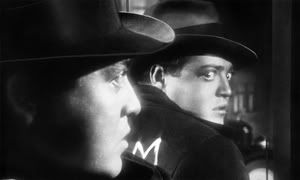
But of course what I loved most about the film was the wealth of iconic imagery, and for that matter iconic sound. For being an early talkie, Lang really made powerful use of sound. And the images are really stunning—the balloon caught in a wire, the empty dinner plate, that wonderful shot of Lorre looking back over his shoulder and finding himself marked. It got me thinking, really, about what it is that makes an image iconic. I think these images (and that whistled bit of Peer Gynt) occupy a space that often lies empty. Rather than lean on a word like interstitial, let's just say that they form a bridge—between the rational and the irrational, or between objective truth and what Herzog calls "ecstatic truth." One the one hand, of course, they succinctly convey information. The ball rolling in the woods tells us that its owner has fallen victim. We learn to hear the whistled tune as an indicator that our antagonist is in the grip of his murderous obsession. But the power of these icons is that, even as they tell us something, they just as crisply direct our emotional reaction. That image of the ball isn't just narrative; it's tragic. The strains of that song aren't just a plot device; they're chilling. I was enraptured by this film, so much so that at first I didn't trust my own judgement. But at some point you have to realize that it isn't accidental. You're in the hands of someone who knows just what he is doing.

In short, if this is what expressionist films are like—even if few are this successfully made—I obviously need to see a lot more of them.

Friday, May 6, 2011

Kele Goodwin — Hymns (2010)

Upon hearing Kele Goodwin, it's hard not to think of Nick Drake. And if you don't pay close attention, it's easy to keep that impression. The music is consistently placid, Goodwin's voice a series of graceful, hushed ripples. But those, of course, are just surface features. These waters run deep, and abound with complexity and life. Where Drake's lyrics are confessional, Goodwin's are self-reflexive. While Drake contemplates his own psyche, Goodwin gazes into a profound, enigmatic world. "There are sails meant never to raise / Never to know the winds," he sings in the title track, "Leaving our ship alone and adrift / Thinking only of where it has been." Not that his music is never personal, of course. But even in a tune about lost love, like "Red String", we find ourselves not in the closed space of a confession booth but somewhere rather more expansive: "The water was dark, but the sunbeam shone bright / And as I dove, day turned to night / The key it sparkled and caught my eye / I grabbed hold and swam towards the sky."

As for Goodwin's singing style, while it does immediately recall Drake, his approach reminds me more of JoĂ£o Gilberto. The vocals are steady and economical, with a cultivated, careful attempt to rein in excess vibrato. He indulges in a bit, just enough to make the songs compelling, but certainly he's at pains to keep from breaking free. The simplicity of the music is also a bit deceptive. The drone underlying many of the songs actually seems to simplify the already sparse guitar. That single, hovering note acts as a base, from which the melody doesn't far depart. The effect is ironically purifying.

The songs themselves are each little myths, filled with talismans & icons, populated by a protagonist with his eyes cast deep into both the past and the future. For mythologists from LĂ©vi-Strauss to Barthes, a defining quality of myth is elements in opposition to each other. We find such elements strewn throughout these songs. Unwanted "paper tears" are saved for ages and fashioned into "warships with fire in their sails." "There's evil in every eye / but love in every face." A key recovered from deep in the sea is immediately thrown back in. Even the simple regrowth of a fallen leaf is imbued with life-sized significance.

If Kele Goodwin's music is not overly dynamic, it is also not the narrow, self-absorbed sort that too often accompanies such an aesthetic. It is music which rewards patient attention.

Friday, April 29, 2011

Diana Jones — High Atmosphere (2011)

A few years ago, after enjoying albums from Noah & The Whale and Thao Nguyen, I made myself a promise not to ignore any artist based solely on their singing voice. That commitment has continued to pay off, not least because it's allowed me to appreciate one of the great songwriters alive today. Diana Jones is often noted for her unique, throaty delivery, and it's not immediately to everyone's taste. It's not so apparent on her most recent album, which may help her find a wider fanbase. What doubtless can't hurt is something that hasn't changed: her skill for writing and performing gripping, beautiful songs. All but one of the songs on High Atmosphere is written (or co-written) by Jones, and virtually all are real gems. The album starts strong, with the anthemic title track, an excellent example of her ability to create instantly classic material—original songs that you'd swear had been handed down for generations. Not that there is anything retro about this music. This isn't neo-country; it's Country. Pure, and deceptively simple.

You might understandably fear that she couldn't sustain the level of the opening track, but fortunately, you'd be wrong. It is immediately followed by "I Don't Know"—the kind of wistful, longing tune that you might expect from Alison Krauss or even Patsy Cline. From there the album paces along beautifully. It's less melancholy than her previous album, though it certainly has its dark moments. But as is always the case with Diana Jones' music, what keeps these songs afloat is the intense grace of the artist herself. Few songs could be sadder than "My Love Is Gone", for example, but the beauty and strength of Jones' presence keeps it from ever sinking. Then too, the quality of the songwriting itself rarely falters. Not everyone can pull off a song as straightforward as "Poverty", nor one as full of insinuation and irony as "Sister". Jones accomplishes both with apparent effortlessness.

It's not as if the album were completely flawless, of course. Truly, though, it is as close to perfect as any in recent memory. Beyond that, it's worth noting that High Atmosphere is the third in a string of very strong releases from the same artist. You'll forgive me, then, if I don't bother mentioning any faults, easy as they are to overlook. This will be one of the two or three best albums of the year, I'm certain. If I'm wrong about that, it's going to be a very good year.

Friday, April 22, 2011

Iron & Wine — Kiss Each Other Clean (2011)

You have to respect Sam Beam's ability to keep re-creating his sound and yet always keep it his. From the iconic home-made beginnings through numerous albums, experimental EPs, collaborations, covers, and beyond, Iron & Wine sounds like Iron & Wine. Given the spare effectiveness of that debut, and the apparently not-too-distant sojourn of Our Endless Numbered Days, you might certainly have expected his sound to stagnate. But since at least 2005 (and further back, if you really listen), Beam has been systematically expanding his scope. While each new release has covered wholly new ground, though, they have maintained a certain distinctive sound, and have been consistently compelling. Not so this time.

Kiss Each Other Clean does explore new ground, while simultaneously maintaining the Iron & Wine throughline. It is not, however, a compelling listen. The songs are good enough—accessible without being saccharine, complex without getting caught up in their own structure, diverse without falling away from each other. But none are great. What they don't do is last. Beam's music has always been gripping. You couldn't help but get caught up in songs like "Upward Over the Mountain", "Each Coming Night", "Jezebel", and "Resurrection Fern". They absorb you as you listen, and linger long after their sounds have gone. Nor was it ever limited to such slow, simple songs—"Freedom Hangs like Heaven" and "History of Lovers" are equally powerful. There is no equivalent on Kiss Each Other Clean. These are songs worth listening to, but hardly worth remembering. Even the best, "Walking Far from Home", begins to fade from memory before it has even ended. "Boy with a Coin", sadly, this is not. A few of the songs do improve a bit with repeated listens, which is fine. Others, however, do not. And none ever seem to rise far above the mean.

I'm inclined to chalk this all up to indulgence. Beam is playing with a lot of sounds, structures, and effects here, "experimenting" in the way that high-schoolers do with sex & drugs. But like most such partakers, he can get carried away, and it does distract attention from more significant pursuits. I'm hopeful that he'll come through it all right and find his way back to what he does so well. It's not his best album, but I don't think it's the end of anything. Sam Beam has a lot more to give, and I'll be anticipating the next album just as eagerly as if this one hadn't happened.

Monday, April 18, 2011

Notorious (1946)


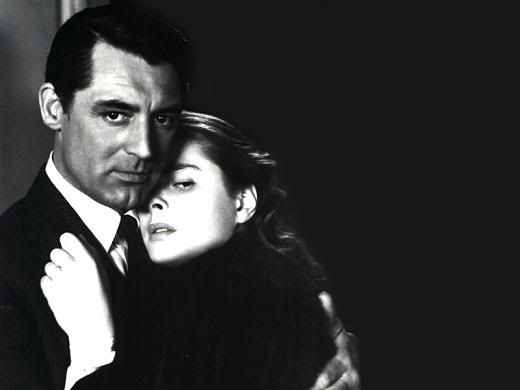
I was a bit underwhelmed by this movie. I didn't have a lot of expectations going in, other than knowing it was Hitchcock and so would have some real suspense. I also expected some great passion between Grant & Bergman, of course. On the first point, I wasn't disappointed. On the second, I was. I like both Cary Grant and Ingrid Bergman, but there didn't seem to be much chemistry between them here. Part of it might have been inordinate amount of time & energy that Hitchcock spent flirting with the Code. It may have been shocking or amusing or otherwise interesting in 1946 to see the two leads in a 3-minute embrace with one 3-second kiss after another. But with the Code long gone, and not knowing about that aspect of the scene beforehand, it looks pretty ridiculous. They seem like a couple of high-schoolers too awkward to really lock lips. And in this context, that clumsiness really detracts from the story. Awkward, after all, is the last word that should apply to these two characters.

So for me, the movie really picked up steam once the two protagonists were torn apart. Watching Bergman go toe-to-toe with Claude Rains was a lot of fun. He's another actor I've always enjoyed, and never more so than here. Hitchcock is a master of tension, and he keeps it drawn very taut between them for long periods of time. His visual style is also very potent in the last half. I loved the shot introducing Sebastian's mother—she's terrifying before she ever says a word. I'm also a big fan of the way Hitchcock can make a single image say so much—the Unica key on Sebastian's keyring, for example, or the 1940 wine label.

All in all, I enjoyed the movie. Not the sizzling love affair everyone talks about, which left me quite cold. But the suspense, and the tension among the triangle of Alicia, Sebastian, and his mother, were very good. It hasn't made me a huge Hitchcock fan, but it hasn't hurt either.

Sunday, April 17, 2011

Stumbling start

I had really expected to post a lot more than this, but in January my "hard drive" (actually a supposedly redundant RAID array) failed and I lost a lot of stuff. Music, movies, all kinds of stuff. It took me a while to get some of it back, and longer still to get over the feeling of (what I can only call) betrayal that the whole episode caused. I'm pretty well back in the saddle now, listening to a lot of new music, etc. But I'm just now getting back to this. I'm actually going to start with a quick movie review, because I was already doing it for another site. But I'm hoping I'll have the focus to start posting music reviews directly.