Friday, June 15, 2012

The Red Shoes (1948)


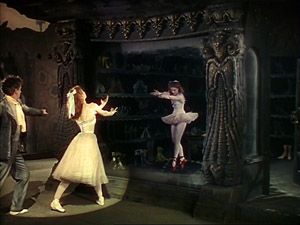
What a revelation this film was. I generally try not to know much about a movie before I see it, and films like this really reward that diligence. I had no expectation going in that I'd see the kind of magic that The Archers put together here. It's a great balance, really, because so much of the film is just straightforward, natural narrative. But in a few moments, and of course in the eponymous extended dance sequence, it slips very naturally into something else. I was searching for what to call it—words like 'surreal' and 'magic' don't seem to fit at all—when I ran across the perfect phrase in a British review: "quietly radical." It's not designed to shock you. It's not even designed to amaze you. It's just that the filmmakers make full use of their medium, while keeping everything perfectly in line with the story they're trying to tell. They manage it beautifully—I was more impressed with their ability to do that than I was with the technical wizardry itself, which is exactly as it should be.

The story itself is not overly original, but it's well told. The more traditional scenes of the film were typically well crafted, of course. The narrative is absorbed in the world of the ballet. As usual with The Archers, the techniques are subtle, but effective. Much of the action takes place in long shots, for example—we often see three or four main characters on screen. Everything seems to happen in a larger context, and the story isn't dominated by the very strong personalities within it. They certainly are strong, though, and propel the story forward nicely.

I did find myself comparing it to (or maybe rather, considering it alongside) Black Swan, and it really has me wondering about this common trope of a woman's self-destructive obsession with her art. Not that there aren't similar male tropes, and not that there aren't other obsessed-female character types. But from Sunset Boulevard through this film and on to today, it seems that a woman is never allowed to be too devoted to her art. It's difficult to imagine such films with the gender roles flipped.

It isn't really a problem (internally) with this film, mind you. Vicky is a full character, not just a trope, and her development as a character is enthralling to watch. Shearer gracefully toes the line between naturalistic and romanticized acting, and it serves the story well. The same is true, by the way, of the two male leads. Anton Walbrook's Lermontov is especially charismatic. He's difficult to love, but hard not to pay attention to. (I don't mean to tie this film too much to Black Swan, but that film would have been greatly improved if Thomas Leroy had been written & performed with more of this subtle charm.)

The Red Shoes was a thrill to watch, and I'm grateful to Filmspotting for turning me on to it. And to The Archers overall—I can't wait to see more from them.

Monday, June 11, 2012

The Tallest Man on Earth — There's No Leaving Now (2012)

Kristian Matsson's music doesn't so much have rough edges as it does rough surfaces. There's an ever-present struggle in his voice, and to a lesser extent in his playing. He seems always to be a bit beyond his comfort zone, stretching to reach a higher note or a more expansive idea. It's easy to be fooled, but that unfinished sound belies the solid structure underneath. In a sense, what makes the music so compelling is that tension between the easy, solid base and the gritty, rough-hewn surface. There is an easy confidence in the songwriting; it's music with a lot more heart than head.

If the music is dependably good, that isn't to say it's static. TMoE is breaking new ground on this album, departing from the guy-with-a-guitar sound that has comprised virtually his entire catalog up to this point. If you stop and pay attention, it's not difficult to imagine how a song like "Revelation Blues" would sound without the atmospherics, rhythm section, etc. But if you take it all at face value, the sound is quite organic.

Nothing sounds like it should be stripped bare, even if you can hear how it could be. The focal point is still Matsson's intricate picking, and that's as gorgeous as ever. If the additional instrumentation & production don't seem integral to the end product, they do add a freshness to his music. This seems like the most organic direction for TMoE's music to grow, and it's good to see him working his way into it.

Mostly, There's No Leaving Now is shot through with grace and beauty. Sometimes it's the songwriting, as on the title track. Often it's Matsson's guitar playing. Occasionally it's just the straining of his voice in fleeting moments, as in the final track. It's another masterful album, which certainly holds up to the high expectations that are resting on it.

Monday, June 4, 2012

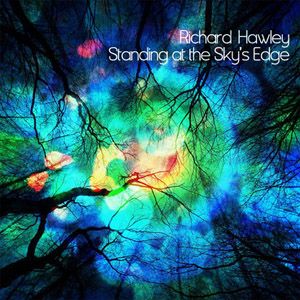
Richard Hawley — Standing at the Sky's Edge (2012)

Richard Hawley's latest album, like one or two before it, fades in slowly. As the sound rises from nothingness, you'll be forgiven if you expect his typical reverb-laden Rickenbacker sound to wash over you. Don't get too comfortable, though—when this album comes on, it hits like a brick wall. With the opener, "She Brings the Light," Hawley is clearly in new territory, and he spends most of the rest of the album exploring it.

There's never been a real throughline in Hawley's album releases. He has always had something of a signature sound, to be sure, but his development from album to album hasn't always followed a clear course—he hasn't been consistently getting heavier, or lighter, or grander. Still, this album feels like a real departure. Beyond the wall-of-sound opening, he's working here with a lot of sonic elements that aren't familiar from his previous work. The title track's bongo interlude, for instance, or the spacey over-production of "Time Will Bring You Winter," will surprise longtime fans. The thing is that these elements work—the sound is mature, fleshed out. If this were the first Richard Hawley album you'd ever heard, you'd have to assume he'd been developing exactly this sound for quite some time.

He does momentarily return to more familiar ground for the pairing of "Seek It" and "Don't Stare at the Sun." They're not bad, but it's not the best material here. Certainly, they don't integrate seamlessly into this album—in the context of so much volume, such songs take on a quaintness that doesn't well suit them. Then again, perhaps it's that Hawley himself is moving on from such spaces, and his lack of engagement is showing. "The Wood Collier's Grave" seems to indicate the latter—simple as it is, it works beautifully, and tracks perfectly back into the crashing "Leave Your Body Behind You." Evidently, Hawley is ready for  a new sound. But if this album is any indication, he'll be just as comfortable and masterful as ever.

Thursday, May 31, 2012

The Day of the Jackal (1973)


For a hitman thriller, there's remarkably little action in this film. The pacing seemed a bit slow as it went on, but only afterward did I realize how successful it had been at maintaining tension throughout the 2-hour–plus runtime. Through the first half or so it focuses almost entirely on our protagonist's methodical preparations for the act. Edward Fox carries us through this handily, his air of quiet nerve a prototype for characters in the genre. He turns this into a wonderfully sympathetic character. I don't want to say that I managed to forget he was a hitman, but actually it was more like I forgot what makes a hitman a hitman. So the first time Fox kills someone, I actually gasped. I saw it coming, I suppose, and yet the performance of it was very much an icy-cold shot of water in the face.

As this lone-actor story begins to blend with the detective story that's been building on the other end, things get considerably more interesting. The most intriguing performance of the film—and my favorite character overall—is Michael Lonsdale as Lebel. His dogged, intelligent determination is beautifully counterpointed by his quiet, controlled demeanor, and together with Derek Jacobi's supporting role, the investigation quickly becomes the driving force of the film. The tension becomes outright suspense, and carries the film through to its climax—which is a bit rushed and a bit incredible, but not enough to really hurt the film. Even if it had, the coda that follows is rich enough to revive it.

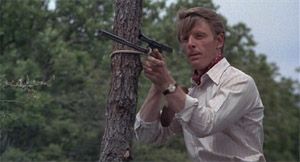
It's a very well crafted film—not showy, but effective, and some of the minute details were really delicious (e.g., his technique for practicing with the rifle, pictured above). It could have been a bit less dry, I suppose, but it simply isn't that kind of film. I enjoyed it as it was.

Wednesday, May 23, 2012

The Magnificent Seven (1960)


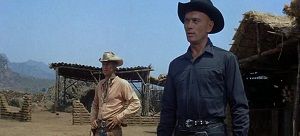
It is probably not fair to say, but this is certainly no Seven Samurai. There are some similarities, though. Aside from the plot, of course, there is the way both films lean heavily on their actors' charisma—and in both cases, there's plenty to lean on. That's probably, in fact, the only thing this one has on its predecessor. Yul Brynner and Steve McQueen, backed by the likes of Eli Wallach, Charles Bronson, and James Coburn? Yeah, personality's not going to be an issue.

For me, though, it wasn't quite enough to support it. The cast exuded cool, in the "not warm" sense of the word. Horst Buchholz' Kikuchiyo Chico is the greatest exception, of course. But honestly, I thought Wallach was the most impressive presence in the film. I have to admit, I wasn't excited at the prospect of watching a Brooklyn Jew play the most significant Mexican character, but I was pleasantly surprised. He didn't strain himself to find authenticity, but did create a complex, rather menacing character. He really felt like the balancing point for the film, and I was glad to see him get more screen time than I remember for his Japanese counterpart.

Review after review of this film describes it as "a lot of fun," or some more masculine equivalent of that. All of which is probably true, if icy cool is your preferred shade of manhood. (For my part, I would rather watch Kelly's Heroes.) Sorry if I spend too much time comparing it to its Japanese predecessor, but honestly, if it didn't have that connection, it would just be another Western. I'm sure I never would have seen it. Still, it's a movie that knows where it's going, and manages to get there.

Thursday, May 17, 2012

The Double Life of Veronique (1991)


If this were the only one of KieÅ›lowski's works I'd seen, I'm sure I'd be quite taken by it. He has a way of tapping into the ephemeral, transitory nature of really important questions, and that's clearly at work here. He beautifully weaves together the mysteries of identity, fate, connection with other human beings—it's a film with a lot to say, and a lot to ask.

In the course of Kieślowski's career, The Double Life of Veronique falls between The Decalogue and the Three Colors trilogy. Unfortunately, I didn't find this film to measure up to either of those series in any important way.

Thematically, Veronique shares plenty of elements with the rest of his oeuvre. That tapestry of questions stretches throughout. But if I imagine the whole thing as a conversation he's having with himself, this film seems more an off-hand remark than a substantive contribution. Take it out, and not much is lost.

Visually, Kieślowski is really never less than a master. He does produce some iconic images here, and in certain moments it's quite poignant. It is never as compelling, though, as his best work. It lacks the raw intimacy of The Decalogue, and the sumptuous immersion of Three Colors. Not that it needs to emulate those other works, any more than they emulate each other. But Veronique simply isn't on the same level. The aesthetic is inconsistent, unfocused, and just when you start to get hooked, it loses its grip.

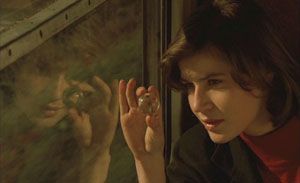
Other aspects of the film are even less impressive. Irene Jacob is spectacular in Red, but here she hits far too many wrong notes. Granted, she isn't given enough to work with. Weronika, in particular, is a giddy girl in a woman's body, searching in every moment for someone else to lean on. The only times she seems at all in control are when she's singing, and unfortunately those moments are seriously marred by the poor lip syncing. I hate to dwell on what would otherwise be a minor technical detail, but it really is critical here.

Veronique is more interesting, but still a bit more bland than she needs to be. Part of the problem with the film in general is KieÅ›lowski's (truly uncharacteristic) impatience in pivotal moments. When Veronique discovers the photo from KrakĂ³w, for instance, she doesn't dwell on it, she doesn't slowly fade. She simply breaks into sobs. Moments like that give the film a kind of skeletal feel, and I'd certainly like them to be fleshed out.

In a similar way, the film suffers from often far-too-direct dialogue. In all of his films, KieÅ›lowski wants to move obliquely through his subject matter, never facing it full on, and never approaching any kind of blunt moralizing or didacticism. He's far more successful in his other work than he is here, unfortunately. The characters in Veronique keep trying to articulate the film's central themes—that sense of detachment, or of a division within oneself. The thrust of the film is to indicate that this feeling can't really be captured, and yet still they keep talking about it.

All that said, and I mean this sincerely, it's a good film. I'm tempted to view it as a starting point for a brilliant director, notwithstanding The Decalogue and the lengthy career that preceded it. If it wasn't the beginning of Kieślowski's career, still it feels like a beginning of some kind. Perhaps as I see more of his early work, I'll find this to be a significant move in a new direction. Even now, it's not hard for me to see how this led into the Three Colors trilogy. And as I said before, if this were all the Kieślowski I'd ever seen, I'd definitely want to see more.

Saturday, March 24, 2012

Anya Marina — Felony Flats (2012)

On the surface, it's easy not to take Anya Marina seriously—the wispy voice, the bottle-blond hair, the coy album cover. And musically, what she's going for isn't terribly complicated. She makes broadly palatable music, borrowing a lot from various genres. A lot depends on the execution. Her approach is a template, and with enough depth and complexity, it can really work. On this—as on her previous albums—there are moments where she pulls it off. "Believe Me I Believe" is a solid example. Her voice drifts in and out of darkly textured electronic polyrhythms, and the contrast is superb. "Heart Stops" achieves the same effect, this time setting her against a lilting bassline and a wall of guitar. Despite very little actual structure, these spaces do give the listener plenty to explore. If she could carry it off for an additional half-hour or so, it would be one hell of an album. Unfortunately, she can't, and moments like this leave one wishing.

In the end, "borrow" is the right word for what Marina is doing. She doesn't immerse herself in any of these genres; she always seems like a visitor. She dips her toes in the acrid waters of punk, grunge, etc., but always there is the sheen of a top-40 star. This formula is exactly what's landed her on buzz-making commercial spots and soundtracks, of course. Such venues exist all around the edge of the mainstream, her home turf. Marina never gets lost in her wanderings; there's always a hook around the next corner. It's easy to listen to, for sure, but after a while it takes some effort just to stay engaged.

That said, and no backhanded compliment intended, maybe it's better not to try and stay engaged. For what it is, Felony Flats is close to pitch-perfect. Marina is alluring, more than fascinating. Her music exists comfortably in the background while you're doing something more interesting, calling your attention just often enough to add to the experience. But never enough to really captivate you.

Saturday, March 17, 2012

Inglourious Basterds (2009)


I have to admit, I was ready to give up on Quentin Tarantino. I'm not a fan of capital-d Directors, by and large, because I think they tend to be self-indulgent and/or pretentious. Tarantino is certainly no exception, especially when it comes to indulgence. The last few films I've seen from him—Four Rooms, Jackie Brown, and certainly Kill Bill—have been more than I could take. I find myself watching them thinking, "Man, this guy is full of himself." Which can be a bit distracting if you're actually interested in, you know, watching the movie. So I wasn't even going to bother seeing Inglourious Basterds, but somehow I heard enough good things to end up putting it on my list. Before I sat down to watch it, though, I was prepared for it to be the last Tarantino film I ever bothered with.

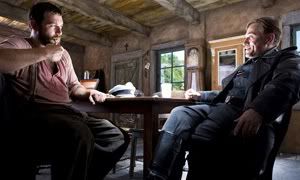
I was pleasantly surprised. This film represents most of what I like about QT, and not much of what I don't. He has always had a wonderful way of drawing out a scene, pulling the suspense tight but not letting it break. The opening scene in the cabin was spectacular, and honestly that set me up to enjoy the film from the start. This particular talent is also where he can be a bit indulgent—the tediously long introduction of Eli Roth's otherwise insignificant character, for example. But for the most part, he keeps it well in check, and most of the suspense has a worthy payoff.

Tarantino's immense knowledge of film convention is another talent which can become an indulgence. He loves to make jokes that only film geeks will understand, and rarely do ten full minutes pass without an homage of some kind. Fair enough, as long as it doesn't intrude on  the film. A few times here, though, he does manage to use that level of understanding to actually improve the story. Parallel plot lines that we expect to collide actually end up merging nicely. Characters are introduced and set up as important, only to be abruptly dispensed with. You end up with very little confidence as to who will survive to see the end of the film, and that's a good thing.

So yes, I enjoyed the film. It was well acted, well directed, and quite a bit of fun to watch. I wouldn't have minded seeing it on the big screen, actually, and next time around I might just give QT another chance. We'll see.

Saturday, March 3, 2012

Tristram Shandy: A Cock and Bull Story (2005)


With a movie like this, you either go along for the ride, or you don't. I did. When Steve Coogan teams up with Michael Winterbottom and Rob Brydon, I'm bound to. And while the humor with this group usually has a lot of ups & downs, I didn't ever feel bored during Tristram Shandy. Coogan plays himself playing himself quite well, and his self-deprecation is pitch-perfect.

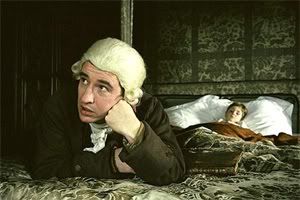
All the meta levels of the film work quite well. It was particularly fun watching the adult Tristram Shandy introduce, and then critique, the actor playing his childhood self. I also appreciated the various transitions where people slip in and out of character, or where the crew step in and out. That was all handled really well, and made it a lot of fun. In the last half, though, as the film gets more and more tied to the off-screen stuff, it loses some of its vigor.

It was a fun film, but felt a bit slight. When it was all over, I had a lesser version of the same feeling I usually get from PoMo stuff, which is basically the resounding question "Why?" It's easier to find the purpose and meaning behind a Judd Apatow movie, I think, than behind so many of the ironically detached exercises that PostModernists love to love. Still, as I said, that reaction was muted with this movie. Mostly because I did find it so funny, and I think that is mostly down to Coogan's performance.

Thursday, March 1, 2012

Days of Heaven (1978)


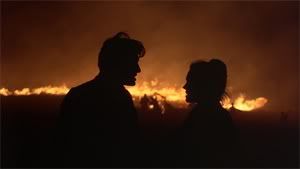
So, I've finally found a Malick film that I'm not wild about. There's plenty to like, and I can certainly see why a lot of people consider it a masterpiece. It's gorgeous, of course—almost every shot is a stunner—and yet that really doesn't detract from the story, which isn't always a given in auteur films. Other technical aspects of the film—the sound especially, and I don't just mean the music—are also quite impressive, and again serve the story well. So far, so good.

But then, there's the actual story. It's certainly pretty standoffish, as far as the emotion goes, but that's so obviously a conscious choice that I have to regard it as disciplined storytelling. The dryness of the telling was certainly in keeping with the film's locale, and the two feed back into each other pretty naturally. So I really didn't mind it. For the most part. I do think, though, that putting Richard Gere in this role was one of the worst casting choices I've ever seen. Especially at this age, Gere is completely incapable of a non-arrogant moment. It's not that he can't display, or even explore, other emotions—sadness, hopelessness, joy, love, envy, or playfulness, for example. It's just that in every one of those moments, his character also seems to be completely full of himself, assured of his own greatness. It doesn't serve this role well. Bill is a character with a lot of brashness, to be sure. It's his driving force, really. But he goes through several significant transformations in the course of the film, and during some of those transitional moments, his self-assuredness doesn't ring at all true. In those moments, the emotional tone of the film doesn't seem dry so much as shallow.

What bothered me much more, though, was the deep misogyny underlying the whole thing. On a second viewing, especially, I was struck by what a slight character Abby really is. If the whole film turns around her, and I think it does, that doesn't mean that she herself is actually important. Rarely does the film, or any one of its characters, ascribe her any real agency. Her fateful decision to go with The Farmer isn't even really her decision, as we're reminded several times. Bill pushes her into it, and she just goes where she's told. Neither does her relationship with The Farmer seem to have any real substance. In a way, she seems to exist simply as an object of desire for both men, and the central conflict of the film is actually just the overlapping of their desires. It's almost homoerotic, frankly. The two men are intimately connected, even though all they really share is a lover.

There's a lot to the film, and I'm certainly glad I watched it (both times). But I didn't come around to it, and I doubt I will try again.