Wednesday, June 22, 2011

Grey Gardens (1975)


I guess I don't get it. I suffered through this movie, with hardly a moment of respite, constantly trying to see what it is that people like or respect about it, and I didn't come up with anything at all. Reading reviews online afterwards, words like "eccentric" and "unique" keep popping up. I suppose there is my first problem. I've known people like this in real life; I've been in their homes, and there's no charm to that existence. Roger Ebert, in his review, describes the film's two subjects as living "amicably" with raccoons. One can't live amicably with feral raccoons—they carry disease, and their feces are toxic. The same is true for the cat urine that apparently soaks this decaying mansion's floors and carpets (not to put too fine a point on it). Grey Gardens is simply a portrait of two intensely codependent ex-social butterflies, living out the ends of their lives in squalor. I don't know what I was supposed to feel about this, but it can't have been the level of repulsion that I did actually feel.

My second problem was at the personal level. Edith and Edie each have their charms, I suppose—Edie more so than her mother, in my opinion—but neither is nearly enough to carry a feature-length film. And the relationship between the two is just deeply dysfunctional. Not really that unusual or interesting, just thoroughly broken. The film seems to want to dwell in the irony of them pushing away from each other while at the same time clingingly desperately to their shared existence. OK, I guess, but isn't that a pretty run-of-the-mill mother-daughter struggle, even if it's taken to a bit of an extreme?

In the end I found nothing to care about in this movie. I did honestly try, for almost the entire length of it, but there was nothing there for me.

Sunday, June 12, 2011

Ran (1985)


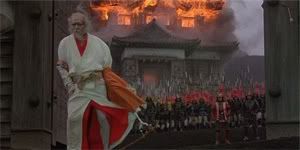
Ran is an engaging tale of human disintegration, at both the levels of the individual and of the family. The setup is perhaps a bit heavy-handed, having Hidetora kill the boar as a way to show us his power, but Kurosawa does complicate it with the old man's show of weakness by falling asleep at the circle afterwards. Saburo is drawn with similar complexity, as are a few of the other roles (Lady Sue comes to mind). But it was the more clearly drawn characters who really drew me into this film. Lady Kaede, Tango, Kurogane, even the scheming Jiro and Taro were more compelling. As an epic, what the film really needed was a driving force, and these characters provided it. In a sense, the complicated character of Hidetora spends the majority of the film simply wandering through the landscape of these clearer minds' making.

The film is masterfully made, progressing steadily from the opening scene to the closing. The former is a display of power—men on horseback atop a grass-covered mountain, in the midst of a boar hunt. The latter is a scene of desolation—a lone blind man, feeling his way back from the perilous edge of a ruined castle wall. Kurosawa paces the story continuously down this trajectory, as both Hidetora and his family fall into ruin. In truly tragic style, the end is always clear. Kyoami, the fool and the film's truth-teller, puts it best when he jokingly tells his lord to "hurry, what with hell so near and heaven so far."

The lingering question of the film is "Why?" What character trait is it that causes Hidetora's world to fall apart? Is it Hidetora's vanity, his impulsiveness? The naked ambition of his sons? The vengeance inspired by his cruelty? I think the answer is that it's all of these things, and in a greater sense, none of them. What the film shows is that his empire is a fragile, complicated structure, held together with little more than his own will and the calcification of custom. When he pulls himself out, like a linchpin, the entire assemblage disintegrates into the Chaos of the film's title.

Friday, June 3, 2011

Elizabethtown (2005)


If I had to describe this movie in one word, that word would be: Bad. Fortunately, I don’t have to, so I can admit that there are some good parts. I can finally see what people like about Cameron Crowe, I think. The best way I can put it is that there’s something comfortable about his movies. You feel yourself just settling into them. With this one I did, anyway.

But I kept getting taken back out of it, in really jarring ways. Kirsten Dunst was fucking horrible in this movie, and I don’t blame her. That was one of the worst-written, most predictable roles ever. It was Hollywood’s version of the Manic Pixie Dream Girl. In every detail, right down to the way she leans in at just the right moment in that last scene (when he finds her at the Farmer’s Market). And the thing is, that role is really typical of the movie as a whole. It was just so unbearably predictable.

Except that with most predictable movies, at least you know what’s coming next. I know that sounds contradictory, but I mean it. This movie was basically a pastiche of really predictable characters and situations—very poorly executed, I might add—interspersed with these unbelievable digressions out into nowhere. The train really went off the rails at the wake. Everything about that was just, wow, just really shockingly bad. [I might add, as a bit of an aside, that Crowe’s characters are really unlikeable. Could they possibly be any more self-obsessed? And the more central the character, the worse they are.] OK: What. The Hell. Were all those people laughing and clapping for when Susan Sarandon was on stage? Was I hallucinating, or did she finish off with a tap-dance number (and then, of course, to truly sell the cliché, did she look at the huge picture of Mitch and mouth the words, “I love you”)? Was that a stand-up–comedy routine she was doing? I must have passed out at some point, because I missed the part where that was in any way relevant to the man they were all there to grieve.

I’m being serious, by the way—I think I passed out at some point. This movie was like a twelve-pound sledge to the frontal lobe. I can barely see straight. The only saving grace, I guess, was that after the wake the movie officially transcended into So-Bad-It’s-Good status. Or at least So-Bad-It’s-Hilarious.

Wow. Just wow wow wow. A lot of people took a lot of drugs to make this movie happen, obviously. And just as with any drug-induced fiasco, I don’t know whether to thank them for the laughs, or just try to move on with my life and pretend the whole sordid thing never even happened. I think I can feel myself starting to repress it, even now.

My Morning Jacket — Circuital (2011)

It was probably unwise for My Morning Jacket to begin this album with "Victory Dance". It's a very good song—inventive, intricate, well-executed. Even the rhapsody at the end isn't as jarring as it might be, because by that time you're well into the song's own world. Really, it's great stuff. You know what I'm about to say next: The problem is that "Victory Dance" sets your expectations far too high. It transitions nicely into the next song, the title track, and that one moves nicely into "The Day Is Coming". But with each subsequent entry, the songwriting gets less interesting, the structure far less intricate, and the execution less impressive. By the time we reach the "Wonderful (The Way I Feel)", which should be disappointingly bland, it turns out to be just bland. Disappointing has come and gone, unnoticed.

To be fair, there are moments of redemption scattered throughout, and things do briefly pick back up in the second half. "Outta My System" is another voyage through blandness, but "Holdin on to Black Metal" isn't. It isn't very good, either, but it does mark the turn in that direction. "First Light" and "You Wanna Freak Out" are pretty good songs. Unfortunately, they are followed by "Slow Slow Tune", really the only bad song on the album*, and the set closes with the forgettable "Movin Away". To be fairer still, the album improves with repeated listens. With ample volume, it's possible to become absorbed in the music—the sound coalesces, and it becomes greater than the sum of the parts. It does plateau at a level well below "Victory Dance", though. I'm sorry to say it, but it seems clear that MMJ will never rediscover the greasy, beautiful psychedelia that made It Still Moves... so great. This album essentially continues Evil Urges' foray through pseudo-psychedelic pop-rock, which simply isn't very fertile territory.

* As a side note, I will never comprehend any artist's urge to include a novelty song on an album. By definition, the song can only become less and less worthwhile, and it really can drag the album down a bit as it goes. In this day of digital distribution, why not pick one of the myriad other ways to 'release' a song like that?

Wednesday, June 1, 2011

Badlands (1973)


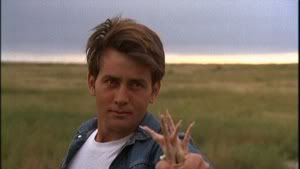
If nothing else, Terrence Malick is a patient filmmaker. He is content to simply spend time with his characters, letting them develop organically rather than putting them through a series of dramatic plot points which can define them clearly. This film develops at its own pace. We watch as Kit spends the morning dumping trash for the city, noticing little details about the people and places along his route and joking around with his co-worker. There's a bit more drama in Holly's narration, but it's muted simply by virtue of being narration, and of course through Spacek's deadpan intonation of it. Though there are moments of foreboding and drama, just as often there are significant moments which pass by almost undetected. The first time we see Kit's gun, for example, it's just there in his pocket as he's moving around Holly's room. This patient, hyper-realist style is an interesting choice, and it has the effect of bringing down to ground level what would otherwise be a larger-than-life story.

The ancillary effect of the style is that it lays the burden of the story directly onto those in front of the camera. It's a great choice, though—if Martin Sheen and Sissy Spacek can't carry your film, it can't be carried. They each fill out their characters wonderfully. Sheen is a charismatic presence immediately. On the page, his character is not so much quirky as deranged, but Sheen manages to lend an air of intrigue to Kit, and to weave his meandering thoughts into a mostly fluid line. For her part, Spacek develops an admittedly personality-free girl into a willful, moral presence.

I had expected this to be a much more somber film, but Malick is playful—most obviously with the music, but also with the irony in Holly's telling of the story, and with the interactions between this pair and the strangers they meet. It's an offbeat film, and an infectious one.

Sunday, May 29, 2011

Raiders of the Lost Ark (1981)


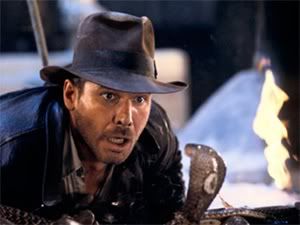
Yeah, this movie's crap. I didn't really expect to like it, but I was hoping it might surprise me. It didn't. A series of over-the-top (in a not-really-good way) adventures which plod along driven primarily by stupid decisions on the part of the protagonist or one of his many nemeses, it mostly failed to elicit any reaction from me at all. The action sequences were comical, like the rest of the movie. I wasn't thrilled by them, I felt nothing for any of the characters, and any time I started to actually care about the purported goal (the ark itself), I got so distracted by the terrible dialog and hammy acting that my concern entirely evaporated. This movie was, as they say, a mile wide and an inch deep. When one of the main characters supposedly dies in the middle of the movie, I couldn't have cared less (and not just because I knew it wasn't real, and the filmmakers would use some flimsy excuse to bring her right back as soon as they felt like it). When the ark is taken away from our heroes only moments after they've recovered it, I couldn't have cared less. And again, not just because I knew that the filmmakers wouldn't even bother straining themselves in coming up with a way for Indy to steal it back. True crises require a bit of trust, and I had none for this film. True suspense requires patience, and Spielberg shows no capacity for that here.

Certainly there are people who like camp more than I do, but I completely fail to see the allure. Making compelling, interesting movies is hard, and purposefully not even trying is a cop-out. Even if you disagree on that, though, what do you get from this kind of movie? Contrary to what seems to be universal opinion, it's not very well made—either technically or narratively. And it's not witty enough to be at all ironic, so what is there to engage with? What's to like? For my part, I didn't find much.

Friday, May 27, 2011

Vieux Farka Touré — The Secret (2011)

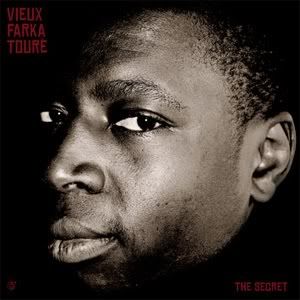
Vieux Farka Touré's music is like a river—flowing, steady, and rhythmic. Moments of peaceful stillness ease into cascades of sound, the flow never really stopping. His most recent album is, fortunately, no exception. It begins steadily enough, and builds to a wonderful climax, one of those rare albums that finishes much stronger than it began. Touré explores some new ground, letting his music get a bet frenetic in parts ("Borei") and delving deeper into a sustained (though not overwhelming) darkness in that final stretch. In all cases, though, this fits the signature that he has been laying down in the four years since his debut album.

Seeing the list of collaborators on the album—including Derek Trucks, Dave Matthews, and John Scofield—one might reasonably fear that Touré would lose his way a bit. Not so, at all. The contribution of Derek Trucks (on "Aigna") blends reasonably well into Touré's sound. And he lays down the strongest groove of his career on "Lakkal", with the help of Ivan Neville & Eric Krasno. As accessible as his music may be to Western ears, it has never really had an American flavor. So while the influence of these musicians is easily noted, they fold in well. The same can't be said for Matthews. He is not at his best here, and his sloppy, faltering vocal style does not hold up well against the tight, exquisite mastery of Touré's music. The song ("All the Same") holds its own, but you can't help wishing for the song it might have been.

Clearly, though, the most fruitful collaboration is with John Scofield on "Gido". It's the album's strongest cut, and one of the best in Touré's catalog. It comes as the album is taking a slightly more serious turn, and it's a sound quite different from the rest of the album, but which fits perfectly where it is. Scofield and Touré develop a mutual energy that is really palpable, lingering for the rest of the set and beyond. It's an compelling, powerful finish, and one that leaves you wishing it could go on much, much longer.

Thursday, May 26, 2011

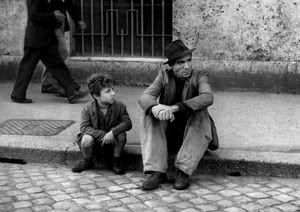
Bicycle Thieves (1948)


Another film filled with iconic imagery, though certainly not in as stylish a way as M. Really, as I think about it, it's more full of iconic scenes, as opposed to just images. I think that's telling, because the primary quality of this film is the way it pulls you down into the story. It's shot and edited very plainly, so that the content itself does the heavy lifting. Not to say that it's a documentary style—it very much feels like a narrative, with scenes leading one into the other, tension crescendoing and falling. But it stays close to the ground, deeply connected to the immediate reality of what's happening.

The integrity of such a portrayal really draws you in. It's probably most evident when we see the picture of Rita Hayworth. It was a bit heavy-handed, of course, but still not wrong—there's a drastic contrast between the life of a Hollywood star (on- or off-screen) and the lives of these people. In a word, Hayworth seems unreal. By contrast, Antonio seems all the more real.

The most spectacular thing about the film, though, might well be Bruno. Really the entire film turns on this one character, and Enzo Staiola does a fabulous job with the role. He provides a moral and emotional anchor for the film, from the moment he appears. And of course, that gradual development is crucial to the film's final passages.

Sunday, May 22, 2011

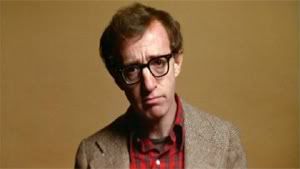
Annie Hall (1977)


I should probably start by saying that I can see what's great about this movie. Especially for its time, and for its genre, it took a lot of risks, and most of them worked out great. Allen breaks all kinds of ground, with both technical and narrative aspects—breaking the 4th wall, non-linear chronology, the novel use of split screens, etc. And truly, almost every one of those things makes this a better movie. I'm not a person who gives credit for experimentation propter se. I want it to actually work, and I want it to serve the story. Most of those techniques do both, and I appreciated Allen's diligence in that regard.

In the end, though, the movie didn't come very close to winning me over. Firstly, I was not at all attached to the two leads. (Or to any of the characters, come to think of it.) Obviously Allen's character is autobiographical to some degree, which didn't actually help. Alvy strikes me as an incredibly shallow character. Ebert describes him as someone who "lives in order to talk about living," and I think that's a great point. He's compulsively disengaged from the world, and seems to have no real drive as a character. Compulsion is a poor substitute. Annie is also not terribly interesting. Obviously Allen sets her up as a foil from the beginning, as he typically does with female characters. She exists to make Alvy seem sophisticated and wise, which she accomplishes by being a wide-eyed rube. I guess I can see what Alvy is supposed to fall in love with, but I myself certainly didn't take the fall.

Perhaps the worse problem, though, is that I didn't find the movie funny. Most of the humor comes off as simple glibness, which again, I think is a poor substitute. It was fitting with the characters, but it wasn't enough to fill out the film. There were a few moments that were genuinely funny, but I would have enjoyed them more if I'd been at all warmed up for them.

I didn't hate Annie Hall; it certainly earned all three of those stars. But it solidified my position: I won't be seeing Hannah and Her Sisters, Manhattan, or any other Woody Allen movies. Crimes and Misdemeanors is still one of my all-time favorites, and I've seen other of his films that I've enjoyed to varying degrees. But I don't think he has anything more to offer me, really. I'm not breaking any new ground, I know, in pointing out that he's cynical and mysogynistic. But he is, and his more positive qualities no longer outweigh it for me.


Friday, May 20, 2011

Fleet Foxes — Helplessness Blues (2011)

There is a rich tradition of musicians, in response to sudden success, reacting with violent opposition to the prospect. Think Nirvana or, more recently, M.I.A.—making music which goes drastically against their newfound fans' expectations, challenging them to prove their devotion. There is an equally rich tradition of artists losing themselves to their own whims, convinced that every inspiration they have is critically important, and trying dutifully to transmit them all to the world at large. Think Guns 'N' Roses, Smashing Pumpkins, or U2. Upon first listening to Helplessness Blues, I assumed it was the former. What other explanation for the decision to begin such an eagerly awaited album with such a thoroughly mediocre song? It might also explain that saxophone breaking in and destroying "The Shrine/An Argument", an otherwise beautiful tune. On the other hand, song titles with slashes in them are an easy indicator that a band has gone the other way, and there are two such songs here. Then too, Pecknold's lyrics are clumsily pretentious more often than they have been on previous releases. In the title track, for instance:
I was raised up believing
I was somehow unique
Like a snowflake distinct among snowflakes
Unique in each way you can see

And now after some thinking
I'd say I'd rather be
A functioning cog in some great machinery
Serving something beyond me
Aside from the triteness of the sentiment itself, we see here a songwriter who can't be bothered with artifices like poetry or challenges like the creation of new metaphors. These are the opening verses of the title track, and the production is such that nothing obscures these lyrics. So it turns out that Fleet Foxes are in that second group of musicians. They may alienate all their fans along the way, but what they're really trying to do is let the world see how important they are.

In spite of all that, it's not a bad album. A few of these indulgences do pay off—"The Plains/Bitter Dancer", in particular. The songs blend together at first, but with repeated listens the cream begins to rise. Certainly they are all an improvement over that middling opener, "Montezuma". Still, the dynamism of their previous work is missing. The scene changes in those slash-titled songs just aren't as compelling as they were in "Mykonos" and "Ragged Wood", and nowhere is there the intrigue of "White Winter Hymnal". If I might grant a back-handed compliment, I would say these songs are better than adequate. The harmonies are familiar and the melodies comfortable, and if Fleet Foxes don't find a lot of new ground this time around, it is still a pleasant space to spend a bit more time in.