Friday, February 10, 2012

The Little Willies — For the Good Times (2012)

There's a lot to like about The Little Willies' long-awaited sophomore release. They're certainly talented, and can be an engaging listen. But the first and last word that will come to mind as you think of The Little Willies must be "fun." Incessantly, doggedly, sometimes tediously fun. Not that there's anything wrong with fun music, of course, and some of the songs here are as good as they've ever been ("If You've Got the Money I've Got the Time" comes to mind).

One might take a bit of offense to how The Willies strip mine classic songs for the extraction of this one pure resource, of course. Even related notions like rowdiness ("Fist City") or sarcasm ("Wide Open Road") are dispensed with in favor of the distilled product. When virtually every song seems to produce a certain mood, one has to wonder whether it's because every song was approached as a means to that end. After the first half hour or so, one might also start to find the whole exercise a bit monotonous.

To be fair, there are a few moments when they're not extracting every drop of bouncy joy from a tune. Some of these—say, for instance, "Permanently Lonely"—suffer from a certain lack of engagement, and do little to mitigate the overall feeling. But when Jones takes over the microphone for the album's final sequence, she ably sells a wider range of emotion. The title track, "Jolene", and "Pennies on the Floor" are all effective. Gathered as they are at the end, they help the album ride off into a convincing sunset.

To some extent, though, it's that lack of engagement which really defines the album. Like many side projects, the performers often seem unable to fully commit. It has the feel of a backyard barbecue performance, where no one's willing to be accused of taking the whole thing too seriously. There are bright spots—the aforementioned "If You've Got the Money" and the opening track, "I Worship You," are firmly in this mold, and work beautifully. But it's not enough to sustain a full album, and the overall product is inconsistent. For my part, I'll give 3 or 4 stars to a few of the songs, and be glad to hear them when they come up on shuffle play. But I doubt I'll revisit the album itself very often.

Saturday, February 4, 2012

Best Albums of 2011

I'm really late with this, but what the hell.

First, a few honorable mentions....


Cults—Cults
"Go Outside" is probably about the catchiest tune of all time, and the album as a whole lives up to it. A bit on the saccharine side, though. "Most Wanted"


Zee Avi—Ghostbird
Tighter than her sophomore attempt, but could do with more of that quirky edge that was so great about her first. "Swell Window"


Steve Earle—I'll Never Get Out of This World Alive
It's good, and I like it, but it never REALLY grabbed me. "The Gulf of Mexico"


Gregg Allman—Low Country Blues
Falls off a bit in the last half, but a damn good blues album. Definitely my #11 of the year. "I Can't Be Satisfied"


Zoe Muth & The Lost High Rollers—Starlight Hotel
A bit kitschy, but solid underneath. "Let's Just Be Friends for Tonight"


Saigon—The Greatest Story Never Told
Well balanced, if not overly deep. "Too Long"


tUnE-yArDs—W H O K I L L
Normally not at all a fan of edgy/avant-garde stuff, but I loved this in spite of myself. "Bizness"


Lykke Li—Wounded Rhymes
A lot of fun. A great debut, and another one that really could have made my top 10. "Get Some"

Every year I miss a few good albums. And every year, it seems that at least one of them would have made my Top 10. Last year I missed . . .


#1 2010 Omission: Kele Goodwin—Hymns
A seductive, beautifully calm album, but one with a lot going on underneath. Goodwin's songs are intricate, woven of iconic—really, mythic—imagery. At the same time, they never seem as fragile as, say, Nick Drake—who has a very similar sound, but not half the depth. I have listened to this album literally hundreds of times over the past year, and I still feel drawn in by it. I can't recommend it highly enough, and I can't wait to hear more from him. [Full review here.]

"Snow" "Hymns" "Feathers"

I don't really consider EPs for the full list, but it seems worth mentioning at least one . . .


#1 EP: Crooked Still—Friends of Fall
It's not truly an EP, I suppose, with seven songs, but on the other hand it is just 23 minutes. Twenty-three solid minutes, which have me trusting that they haven't lost what they found a year ago on Some Strange Country. Their sound crystallized on that album, more than it had previously, and it retains that strength here. Their technical proficiency is as present as ever, but they also manage to make just beautiful, engaging bluegrass. They really seem to have hit their stride.

"Morning Bugle" "It'll End Too Soon"

And finally, on to the list proper. I'm sad to say it, but there is really only one artist here that I wasn't already a fan of from previous work. For an array of reasons, I didn't explore a lot of new music this year. And in the last few months, when I usually push myself to really find some new stuff, I just couldn't find anything that felt like it was worth the effort. So I won't rule out the possibility that it just wasn't a good year for new artists, or for surprisingly good stuff from artists I didn't like before. But more likely, I just wasn't stretching out very far. I'm hoping to do better next year, either way. Still, this is a good list, and these are certainly some fine albums.


10.Trombone Shorty—For True
Shorty just keeps doing what he does so well. The musical stew he puts together is as natural as ever, and a lot of fun to get immersed in. I don't mean to say that he's not doing anything new, either, but in a way it seems that that itself is simply a part of what he does. He's tightened up his lyrics/vocals on this one, which I really appreciate, because that's always been a weak spot. Strong, and getting stronger, if this album is any indication.

"Buckjump" "UNC"


9.Florence + The Machine—Ceremonials
I liked their last album, but there was a layer of complexity to it that always struck me as artificial. This album is a bit more straightforward, and seems more genuine. Honestly, I can see how fans of the previous album might regard this one as too simplistic or something (too accessible, frankly). It does flirt with selling out, I guess, but I doubt they'll ever really cross that line. Here's hoping. The balance on this album is about right.

"What the Water Gave Me" "Heartlines"


8.Danger Mouse & Daniele Luppi—Rome
With the help of some great work by Norah Jones & Jack White, this composer/producer combo have managed to craft a really wonderful modern-day tribute to the music of so many spaghetti Westerns. It's the kind of project I would normally find uninteresting on many levels, but the artistry here is pretty compelling. They set a real mood from the first few beats, and explore it beautifully for over an hour. If I have any problem with the album, it's probably that it is restricted to that narrow concept—it doesn't break a lot of new ground. Still, it's expertly done, and certainly not difficult to listen to.

"Black" "Two Against One"


7.Black Joe Lewis & The Honeybears—Scandalous
I won't be the first or last to say that this album could easily be a lost R&B classic from the '60s. I'm hesitant even to say something like that, though, because it might give the impression that there's something derivative or unoriginal about this music, which there certainly isn't. There's not a false moment on this album, as far as I can tell. It's just sweaty, fun, and desperately good.

"Livin' in the Jungle" "She's So Scandalous"


6.Diana Jones—High Atmosphere
Jones' songwriting has always been really strong, and for the most part, this album is no exception. Her vocals & musicianship, meanwhile, have never been stronger. There is an anthemic quality to many of these songs, not least the title song itself, and it tends to linger with you long after the last song has faded. [Full review here.]

"My Love Is Gone" "High Atmosphere"


5.Vieux Farka Touré—The Secret
I have to admit, I was a bit concerned when I saw the list of guest artists on this one—which, by the way, includes Derek Trucks, Jon Scofield, and Dave Matthews. Not that the artists themselves were a concern (though Matthews does ruin an otherwise pretty great song), but when an artist like this starts to collaborate with a lot of established American musicians, his work can tend to get diluted in the process. Fortunately, what happens here is very much the opposite. Touré shows plenty of flexibility and competency here, and his music expands quite organically to include these disparate elements. It's his strongest work to date. (And "Gido", by the way, was probably my favorite song of the year.) [Full review here.]

"Gido" "Wonda Guay"


4.Gillian Welch—The Harrow & The Harvest
Welch is really in peak form here—it's hard to see how she gets any better than this. From start to finish, this is a masterful performance—the songs are well written, and beautifully performed. The production is about perfect—textured and engaging. It's her most consistent album, and you can really sink into it. If I have a complaint, it's that the album's boundaries are narrowly drawn. Within them, though, you're in very good hands.

"Silver Dagger" "Down along the Dixie Line"


3.Beirut—The Rip Tide
After Zach Condon's last couple of releases, I really thought Beirut would just fade from consciousness. I almost didn't bother giving this a listen, and what a mistake that would have been. With one exception (the misguided "Santa Fe"), this album marks a real return to form for Condon. Instrumentally, he's back to the eastern-European instrumentation where he is so comfortable. Musically, though, he's begun to really outgrow any such easily identifiable influences. This is probably his most original album, and it's very strong.

"Goshen" "Vagabond"


2.Thao & Mirah—Thao & Mirah
Even for two such diverse artists, this album is pretty unexpected. Really, it should be considered a trio with the producer, Merrill Garbus (of tUnE-yArDs—see above). And it's a very fruitful collaboration. All three take risks throughout, and it's obvious that they weren't settling for just experimentation. Each idea is cared for, nurtured, fully realized, and virtually every one lands. The sound may be sparse, or it may be flooded with random noises. The song may be intricately composed, or have a thrown-together quality. The performance may be careful, or it may be joyfully spontaneous. But in each instance, it works. [Full review here.]

"How Dare You" "Hallelujah"


1.Eilen Jewell—Queen of the Minor Key
I fell in love with this album right away, and then I kept waiting for that initial reaction to fade. I'm still waiting. Eilen Jewell is one of the strongest songwriters around, and she & her band give a hell of a performance. This album is a tour de force, exploring the disparate cross-genre territory that can only be called Americana. (You might say the same thing of her entire career, actually.) If there's anything that intimidates Jewell, she has yet to find it—whether on a fast rocker like the title track, a dirge-y torch song such as "Only One", or even a novelty track like "Bang Bang Bang", Jewell and her band simply don't fail.

"Home to Me" "That's Where I'm Going" "Reckless"

___________________________


By the way, if you're interested, I threw together a playlist of all the songs mentioned here. They are in this order, so there are some pretty rough segues, but there it is.

Saturday, July 16, 2011

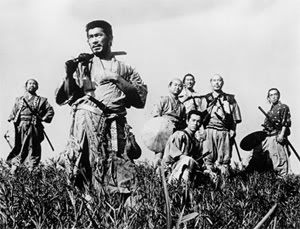
Seven Samurai (1954)


I'm surprised at how much I enjoyed this movie. First of all, not to sound pedestrian, but I'm impressed that a Japanese movie from the '50s was able to keep my interest for 3+ hours, much less to be as fun as it was to watch. Secondly, one of the main characters (Mifune's Kikuchiyo) should have really annoyed the hell out of me, but he didn't. This is a little bit due to some great writing—he's a beautifully complex character—but even more due to Mifune's performance. Believe it or not, this is the first movie I've seen him in. He was really engaging to watch, throughout. I have to say, though, that Takashi Shimura was the actor that really brought me into the film. His charisma reminded me most of John Wayne—just this smoldering presence on screen, who won't allow you to turn away from him.

The film itself was superbly made. It really isn't difficult to spend 3 hours with these characters. The ensemble cast is well filled out, with great roles well performed. At least four of the samurai, as well as quite a few of the villagers, had compelling arcs to follow. The female characters were not so present, unfortunately. Obviously there was a tendency to that, since all of the samurai were men. Shino is a real presence in the film, but it would have been nice to hear more from other peasant women. One or two have moments where you catch a glimpse of a backstory, but they could have been given more time. Obviously I'm not arguing that the film should have been longer, but surely we could have spent less time dwelling (for instance) on the drunken samurai in town who takes their rice and then cowers in his bunk.

I did enjoy the love-story subplot with Shino and Katsushiro. Their discovery of each other was engaging, and their relationship beautifully exemplified the tension between the samurai and the farmers which underlies the entire story. That class tension was the most interesting aspect of the movie, especially as Kurosawa mostly chose to work with it in oblique angles. The final scenes—where the surviving three samurai watch the farmers joyfully going about their work, and we watch Katsushiro struggling with his choice to leave—are the most poignant of the film. (One thing I did love about that, by the way, was that Shino had already made her choice, and she didn't simply cling to him, begging him not to leave. One wonders, if he'd chosen to stay, whether she'd even have let him.)

Aesthetically, Kurosawa is of course a master. I really enjoyed his sense of composition throughout the movie. While not many of the shots are as dramatic as, say, Ran, they have a subtle beauty—and often a subtle significance—that really makes them stand well on their own. And finally, not to drag this review on, but I was really affected by the brief appearance of the flag. There is a lot going on there, touching on elements of nationalism, solidarity, and the power of symbols, which I found myself really thinking about in a new light. It certainly wasn't the most conspicuous symbol in the film (the four swords sticking out from the graves would probably take that honor), but there was a kind of magic that took place in the making and use of that flag that was more than the sum of its actions.

I enjoyed this film even more than I expected to. I responded to Ran largely in that I recognized its significance. Not to say I didn't enjoy it, but that enjoyment was perhaps outweighed by my appreciation of it. Those proportions were reversed for this film. While I did appreciate its significance (e.g., I really want to see The Magnificent Seven now), mostly I enjoyed watching it (and so I really want to see The Magnificent Seven now).

Wednesday, June 22, 2011

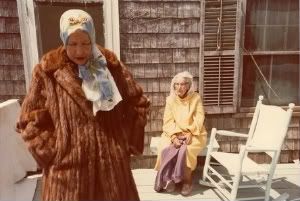
Grey Gardens (1975)


I guess I don't get it. I suffered through this movie, with hardly a moment of respite, constantly trying to see what it is that people like or respect about it, and I didn't come up with anything at all. Reading reviews online afterwards, words like "eccentric" and "unique" keep popping up. I suppose there is my first problem. I've known people like this in real life; I've been in their homes, and there's no charm to that existence. Roger Ebert, in his review, describes the film's two subjects as living "amicably" with raccoons. One can't live amicably with feral raccoons—they carry disease, and their feces are toxic. The same is true for the cat urine that apparently soaks this decaying mansion's floors and carpets (not to put too fine a point on it). Grey Gardens is simply a portrait of two intensely codependent ex-social butterflies, living out the ends of their lives in squalor. I don't know what I was supposed to feel about this, but it can't have been the level of repulsion that I did actually feel.

My second problem was at the personal level. Edith and Edie each have their charms, I suppose—Edie more so than her mother, in my opinion—but neither is nearly enough to carry a feature-length film. And the relationship between the two is just deeply dysfunctional. Not really that unusual or interesting, just thoroughly broken. The film seems to want to dwell in the irony of them pushing away from each other while at the same time clingingly desperately to their shared existence. OK, I guess, but isn't that a pretty run-of-the-mill mother-daughter struggle, even if it's taken to a bit of an extreme?

In the end I found nothing to care about in this movie. I did honestly try, for almost the entire length of it, but there was nothing there for me.

Sunday, June 12, 2011

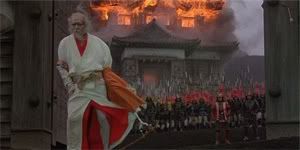
Ran (1985)


Ran is an engaging tale of human disintegration, at both the levels of the individual and of the family. The setup is perhaps a bit heavy-handed, having Hidetora kill the boar as a way to show us his power, but Kurosawa does complicate it with the old man's show of weakness by falling asleep at the circle afterwards. Saburo is drawn with similar complexity, as are a few of the other roles (Lady Sue comes to mind). But it was the more clearly drawn characters who really drew me into this film. Lady Kaede, Tango, Kurogane, even the scheming Jiro and Taro were more compelling. As an epic, what the film really needed was a driving force, and these characters provided it. In a sense, the complicated character of Hidetora spends the majority of the film simply wandering through the landscape of these clearer minds' making.

The film is masterfully made, progressing steadily from the opening scene to the closing. The former is a display of power—men on horseback atop a grass-covered mountain, in the midst of a boar hunt. The latter is a scene of desolation—a lone blind man, feeling his way back from the perilous edge of a ruined castle wall. Kurosawa paces the story continuously down this trajectory, as both Hidetora and his family fall into ruin. In truly tragic style, the end is always clear. Kyoami, the fool and the film's truth-teller, puts it best when he jokingly tells his lord to "hurry, what with hell so near and heaven so far."

The lingering question of the film is "Why?" What character trait is it that causes Hidetora's world to fall apart? Is it Hidetora's vanity, his impulsiveness? The naked ambition of his sons? The vengeance inspired by his cruelty? I think the answer is that it's all of these things, and in a greater sense, none of them. What the film shows is that his empire is a fragile, complicated structure, held together with little more than his own will and the calcification of custom. When he pulls himself out, like a linchpin, the entire assemblage disintegrates into the Chaos of the film's title.

Friday, June 3, 2011

Elizabethtown (2005)


If I had to describe this movie in one word, that word would be: Bad. Fortunately, I don’t have to, so I can admit that there are some good parts. I can finally see what people like about Cameron Crowe, I think. The best way I can put it is that there’s something comfortable about his movies. You feel yourself just settling into them. With this one I did, anyway.

But I kept getting taken back out of it, in really jarring ways. Kirsten Dunst was fucking horrible in this movie, and I don’t blame her. That was one of the worst-written, most predictable roles ever. It was Hollywood’s version of the Manic Pixie Dream Girl. In every detail, right down to the way she leans in at just the right moment in that last scene (when he finds her at the Farmer’s Market). And the thing is, that role is really typical of the movie as a whole. It was just so unbearably predictable.

Except that with most predictable movies, at least you know what’s coming next. I know that sounds contradictory, but I mean it. This movie was basically a pastiche of really predictable characters and situations—very poorly executed, I might add—interspersed with these unbelievable digressions out into nowhere. The train really went off the rails at the wake. Everything about that was just, wow, just really shockingly bad. [I might add, as a bit of an aside, that Crowe’s characters are really unlikeable. Could they possibly be any more self-obsessed? And the more central the character, the worse they are.] OK: What. The Hell. Were all those people laughing and clapping for when Susan Sarandon was on stage? Was I hallucinating, or did she finish off with a tap-dance number (and then, of course, to truly sell the cliché, did she look at the huge picture of Mitch and mouth the words, “I love you”)? Was that a stand-up–comedy routine she was doing? I must have passed out at some point, because I missed the part where that was in any way relevant to the man they were all there to grieve.

I’m being serious, by the way—I think I passed out at some point. This movie was like a twelve-pound sledge to the frontal lobe. I can barely see straight. The only saving grace, I guess, was that after the wake the movie officially transcended into So-Bad-It’s-Good status. Or at least So-Bad-It’s-Hilarious.

Wow. Just wow wow wow. A lot of people took a lot of drugs to make this movie happen, obviously. And just as with any drug-induced fiasco, I don’t know whether to thank them for the laughs, or just try to move on with my life and pretend the whole sordid thing never even happened. I think I can feel myself starting to repress it, even now.

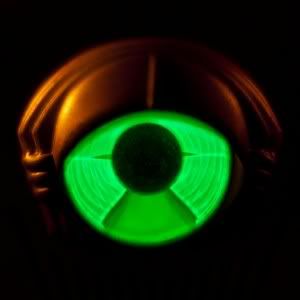
My Morning Jacket — Circuital (2011)

It was probably unwise for My Morning Jacket to begin this album with "Victory Dance". It's a very good song—inventive, intricate, well-executed. Even the rhapsody at the end isn't as jarring as it might be, because by that time you're well into the song's own world. Really, it's great stuff. You know what I'm about to say next: The problem is that "Victory Dance" sets your expectations far too high. It transitions nicely into the next song, the title track, and that one moves nicely into "The Day Is Coming". But with each subsequent entry, the songwriting gets less interesting, the structure far less intricate, and the execution less impressive. By the time we reach the "Wonderful (The Way I Feel)", which should be disappointingly bland, it turns out to be just bland. Disappointing has come and gone, unnoticed.

To be fair, there are moments of redemption scattered throughout, and things do briefly pick back up in the second half. "Outta My System" is another voyage through blandness, but "Holdin on to Black Metal" isn't. It isn't very good, either, but it does mark the turn in that direction. "First Light" and "You Wanna Freak Out" are pretty good songs. Unfortunately, they are followed by "Slow Slow Tune", really the only bad song on the album*, and the set closes with the forgettable "Movin Away". To be fairer still, the album improves with repeated listens. With ample volume, it's possible to become absorbed in the music—the sound coalesces, and it becomes greater than the sum of the parts. It does plateau at a level well below "Victory Dance", though. I'm sorry to say it, but it seems clear that MMJ will never rediscover the greasy, beautiful psychedelia that made It Still Moves... so great. This album essentially continues Evil Urges' foray through pseudo-psychedelic pop-rock, which simply isn't very fertile territory.

* As a side note, I will never comprehend any artist's urge to include a novelty song on an album. By definition, the song can only become less and less worthwhile, and it really can drag the album down a bit as it goes. In this day of digital distribution, why not pick one of the myriad other ways to 'release' a song like that?

Wednesday, June 1, 2011

Badlands (1973)


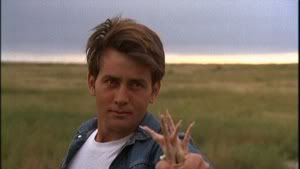
If nothing else, Terrence Malick is a patient filmmaker. He is content to simply spend time with his characters, letting them develop organically rather than putting them through a series of dramatic plot points which can define them clearly. This film develops at its own pace. We watch as Kit spends the morning dumping trash for the city, noticing little details about the people and places along his route and joking around with his co-worker. There's a bit more drama in Holly's narration, but it's muted simply by virtue of being narration, and of course through Spacek's deadpan intonation of it. Though there are moments of foreboding and drama, just as often there are significant moments which pass by almost undetected. The first time we see Kit's gun, for example, it's just there in his pocket as he's moving around Holly's room. This patient, hyper-realist style is an interesting choice, and it has the effect of bringing down to ground level what would otherwise be a larger-than-life story.

The ancillary effect of the style is that it lays the burden of the story directly onto those in front of the camera. It's a great choice, though—if Martin Sheen and Sissy Spacek can't carry your film, it can't be carried. They each fill out their characters wonderfully. Sheen is a charismatic presence immediately. On the page, his character is not so much quirky as deranged, but Sheen manages to lend an air of intrigue to Kit, and to weave his meandering thoughts into a mostly fluid line. For her part, Spacek develops an admittedly personality-free girl into a willful, moral presence.

I had expected this to be a much more somber film, but Malick is playful—most obviously with the music, but also with the irony in Holly's telling of the story, and with the interactions between this pair and the strangers they meet. It's an offbeat film, and an infectious one.

Sunday, May 29, 2011

Raiders of the Lost Ark (1981)


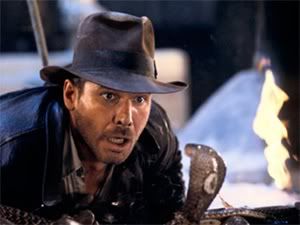
Yeah, this movie's crap. I didn't really expect to like it, but I was hoping it might surprise me. It didn't. A series of over-the-top (in a not-really-good way) adventures which plod along driven primarily by stupid decisions on the part of the protagonist or one of his many nemeses, it mostly failed to elicit any reaction from me at all. The action sequences were comical, like the rest of the movie. I wasn't thrilled by them, I felt nothing for any of the characters, and any time I started to actually care about the purported goal (the ark itself), I got so distracted by the terrible dialog and hammy acting that my concern entirely evaporated. This movie was, as they say, a mile wide and an inch deep. When one of the main characters supposedly dies in the middle of the movie, I couldn't have cared less (and not just because I knew it wasn't real, and the filmmakers would use some flimsy excuse to bring her right back as soon as they felt like it). When the ark is taken away from our heroes only moments after they've recovered it, I couldn't have cared less. And again, not just because I knew that the filmmakers wouldn't even bother straining themselves in coming up with a way for Indy to steal it back. True crises require a bit of trust, and I had none for this film. True suspense requires patience, and Spielberg shows no capacity for that here.

Certainly there are people who like camp more than I do, but I completely fail to see the allure. Making compelling, interesting movies is hard, and purposefully not even trying is a cop-out. Even if you disagree on that, though, what do you get from this kind of movie? Contrary to what seems to be universal opinion, it's not very well made—either technically or narratively. And it's not witty enough to be at all ironic, so what is there to engage with? What's to like? For my part, I didn't find much.

Friday, May 27, 2011

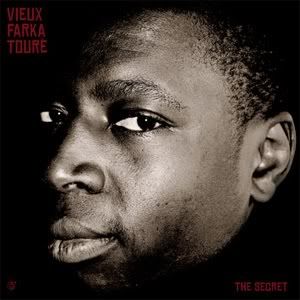
Vieux Farka Touré — The Secret (2011)

Vieux Farka Touré's music is like a river—flowing, steady, and rhythmic. Moments of peaceful stillness ease into cascades of sound, the flow never really stopping. His most recent album is, fortunately, no exception. It begins steadily enough, and builds to a wonderful climax, one of those rare albums that finishes much stronger than it began. Touré explores some new ground, letting his music get a bet frenetic in parts ("Borei") and delving deeper into a sustained (though not overwhelming) darkness in that final stretch. In all cases, though, this fits the signature that he has been laying down in the four years since his debut album.

Seeing the list of collaborators on the album—including Derek Trucks, Dave Matthews, and John Scofield—one might reasonably fear that Touré would lose his way a bit. Not so, at all. The contribution of Derek Trucks (on "Aigna") blends reasonably well into Touré's sound. And he lays down the strongest groove of his career on "Lakkal", with the help of Ivan Neville & Eric Krasno. As accessible as his music may be to Western ears, it has never really had an American flavor. So while the influence of these musicians is easily noted, they fold in well. The same can't be said for Matthews. He is not at his best here, and his sloppy, faltering vocal style does not hold up well against the tight, exquisite mastery of Touré's music. The song ("All the Same") holds its own, but you can't help wishing for the song it might have been.

Clearly, though, the most fruitful collaboration is with John Scofield on "Gido". It's the album's strongest cut, and one of the best in Touré's catalog. It comes as the album is taking a slightly more serious turn, and it's a sound quite different from the rest of the album, but which fits perfectly where it is. Scofield and Touré develop a mutual energy that is really palpable, lingering for the rest of the set and beyond. It's an compelling, powerful finish, and one that leaves you wishing it could go on much, much longer.