Thursday, May 31, 2012

The Day of the Jackal (1973)


For a hitman thriller, there's remarkably little action in this film. The pacing seemed a bit slow as it went on, but only afterward did I realize how successful it had been at maintaining tension throughout the 2-hour–plus runtime. Through the first half or so it focuses almost entirely on our protagonist's methodical preparations for the act. Edward Fox carries us through this handily, his air of quiet nerve a prototype for characters in the genre. He turns this into a wonderfully sympathetic character. I don't want to say that I managed to forget he was a hitman, but actually it was more like I forgot what makes a hitman a hitman. So the first time Fox kills someone, I actually gasped. I saw it coming, I suppose, and yet the performance of it was very much an icy-cold shot of water in the face.

As this lone-actor story begins to blend with the detective story that's been building on the other end, things get considerably more interesting. The most intriguing performance of the film—and my favorite character overall—is Michael Lonsdale as Lebel. His dogged, intelligent determination is beautifully counterpointed by his quiet, controlled demeanor, and together with Derek Jacobi's supporting role, the investigation quickly becomes the driving force of the film. The tension becomes outright suspense, and carries the film through to its climax—which is a bit rushed and a bit incredible, but not enough to really hurt the film. Even if it had, the coda that follows is rich enough to revive it.

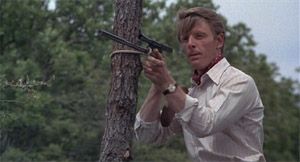
It's a very well crafted film—not showy, but effective, and some of the minute details were really delicious (e.g., his technique for practicing with the rifle, pictured above). It could have been a bit less dry, I suppose, but it simply isn't that kind of film. I enjoyed it as it was.

Wednesday, May 23, 2012

The Magnificent Seven (1960)


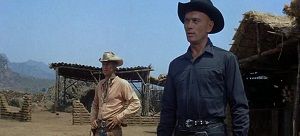
It is probably not fair to say, but this is certainly no Seven Samurai. There are some similarities, though. Aside from the plot, of course, there is the way both films lean heavily on their actors' charisma—and in both cases, there's plenty to lean on. That's probably, in fact, the only thing this one has on its predecessor. Yul Brynner and Steve McQueen, backed by the likes of Eli Wallach, Charles Bronson, and James Coburn? Yeah, personality's not going to be an issue.

For me, though, it wasn't quite enough to support it. The cast exuded cool, in the "not warm" sense of the word. Horst Buchholz' Kikuchiyo Chico is the greatest exception, of course. But honestly, I thought Wallach was the most impressive presence in the film. I have to admit, I wasn't excited at the prospect of watching a Brooklyn Jew play the most significant Mexican character, but I was pleasantly surprised. He didn't strain himself to find authenticity, but did create a complex, rather menacing character. He really felt like the balancing point for the film, and I was glad to see him get more screen time than I remember for his Japanese counterpart.

Review after review of this film describes it as "a lot of fun," or some more masculine equivalent of that. All of which is probably true, if icy cool is your preferred shade of manhood. (For my part, I would rather watch Kelly's Heroes.) Sorry if I spend too much time comparing it to its Japanese predecessor, but honestly, if it didn't have that connection, it would just be another Western. I'm sure I never would have seen it. Still, it's a movie that knows where it's going, and manages to get there.

Thursday, May 17, 2012

The Double Life of Veronique (1991)


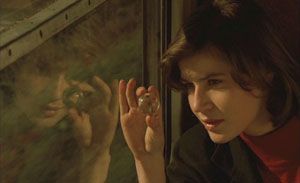
If this were the only one of Kieślowski's works I'd seen, I'm sure I'd be quite taken by it. He has a way of tapping into the ephemeral, transitory nature of really important questions, and that's clearly at work here. He beautifully weaves together the mysteries of identity, fate, connection with other human beings—it's a film with a lot to say, and a lot to ask.

In the course of Kieślowski's career, The Double Life of Veronique falls between The Decalogue and the Three Colors trilogy. Unfortunately, I didn't find this film to measure up to either of those series in any important way.

Thematically, Veronique shares plenty of elements with the rest of his oeuvre. That tapestry of questions stretches throughout. But if I imagine the whole thing as a conversation he's having with himself, this film seems more an off-hand remark than a substantive contribution. Take it out, and not much is lost.

Visually, Kieślowski is really never less than a master. He does produce some iconic images here, and in certain moments it's quite poignant. It is never as compelling, though, as his best work. It lacks the raw intimacy of The Decalogue, and the sumptuous immersion of Three Colors. Not that it needs to emulate those other works, any more than they emulate each other. But Veronique simply isn't on the same level. The aesthetic is inconsistent, unfocused, and just when you start to get hooked, it loses its grip.

Other aspects of the film are even less impressive. Irene Jacob is spectacular in Red, but here she hits far too many wrong notes. Granted, she isn't given enough to work with. Weronika, in particular, is a giddy girl in a woman's body, searching in every moment for someone else to lean on. The only times she seems at all in control are when she's singing, and unfortunately those moments are seriously marred by the poor lip syncing. I hate to dwell on what would otherwise be a minor technical detail, but it really is critical here.

Veronique is more interesting, but still a bit more bland than she needs to be. Part of the problem with the film in general is Kieślowski's (truly uncharacteristic) impatience in pivotal moments. When Veronique discovers the photo from Kraków, for instance, she doesn't dwell on it, she doesn't slowly fade. She simply breaks into sobs. Moments like that give the film a kind of skeletal feel, and I'd certainly like them to be fleshed out.

In a similar way, the film suffers from often far-too-direct dialogue. In all of his films, Kieślowski wants to move obliquely through his subject matter, never facing it full on, and never approaching any kind of blunt moralizing or didacticism. He's far more successful in his other work than he is here, unfortunately. The characters in Veronique keep trying to articulate the film's central themes—that sense of detachment, or of a division within oneself. The thrust of the film is to indicate that this feeling can't really be captured, and yet still they keep talking about it.

All that said, and I mean this sincerely, it's a good film. I'm tempted to view it as a starting point for a brilliant director, notwithstanding The Decalogue and the lengthy career that preceded it. If it wasn't the beginning of Kieślowski's career, still it feels like a beginning of some kind. Perhaps as I see more of his early work, I'll find this to be a significant move in a new direction. Even now, it's not hard for me to see how this led into the Three Colors trilogy. And as I said before, if this were all the Kieślowski I'd ever seen, I'd definitely want to see more.

Saturday, March 24, 2012

Anya Marina — Felony Flats (2012)

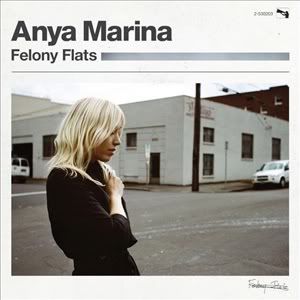
On the surface, it's easy not to take Anya Marina seriously—the wispy voice, the bottle-blond hair, the coy album cover. And musically, what she's going for isn't terribly complicated. She makes broadly palatable music, borrowing a lot from various genres. A lot depends on the execution. Her approach is a template, and with enough depth and complexity, it can really work. On this—as on her previous albums—there are moments where she pulls it off. "Believe Me I Believe" is a solid example. Her voice drifts in and out of darkly textured electronic polyrhythms, and the contrast is superb. "Heart Stops" achieves the same effect, this time setting her against a lilting bassline and a wall of guitar. Despite very little actual structure, these spaces do give the listener plenty to explore. If she could carry it off for an additional half-hour or so, it would be one hell of an album. Unfortunately, she can't, and moments like this leave one wishing.

In the end, "borrow" is the right word for what Marina is doing. She doesn't immerse herself in any of these genres; she always seems like a visitor. She dips her toes in the acrid waters of punk, grunge, etc., but always there is the sheen of a top-40 star. This formula is exactly what's landed her on buzz-making commercial spots and soundtracks, of course. Such venues exist all around the edge of the mainstream, her home turf. Marina never gets lost in her wanderings; there's always a hook around the next corner. It's easy to listen to, for sure, but after a while it takes some effort just to stay engaged.

That said, and no backhanded compliment intended, maybe it's better not to try and stay engaged. For what it is, Felony Flats is close to pitch-perfect. Marina is alluring, more than fascinating. Her music exists comfortably in the background while you're doing something more interesting, calling your attention just often enough to add to the experience. But never enough to really captivate you.

Saturday, March 17, 2012

Inglourious Basterds (2009)


I have to admit, I was ready to give up on Quentin Tarantino. I'm not a fan of capital-d Directors, by and large, because I think they tend to be self-indulgent and/or pretentious. Tarantino is certainly no exception, especially when it comes to indulgence. The last few films I've seen from him—Four Rooms, Jackie Brown, and certainly Kill Bill—have been more than I could take. I find myself watching them thinking, "Man, this guy is full of himself." Which can be a bit distracting if you're actually interested in, you know, watching the movie. So I wasn't even going to bother seeing Inglourious Basterds, but somehow I heard enough good things to end up putting it on my list. Before I sat down to watch it, though, I was prepared for it to be the last Tarantino film I ever bothered with.

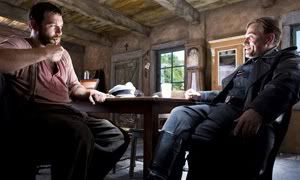
I was pleasantly surprised. This film represents most of what I like about QT, and not much of what I don't. He has always had a wonderful way of drawing out a scene, pulling the suspense tight but not letting it break. The opening scene in the cabin was spectacular, and honestly that set me up to enjoy the film from the start. This particular talent is also where he can be a bit indulgent—the tediously long introduction of Eli Roth's otherwise insignificant character, for example. But for the most part, he keeps it well in check, and most of the suspense has a worthy payoff.

Tarantino's immense knowledge of film convention is another talent which can become an indulgence. He loves to make jokes that only film geeks will understand, and rarely do ten full minutes pass without an homage of some kind. Fair enough, as long as it doesn't intrude on  the film. A few times here, though, he does manage to use that level of understanding to actually improve the story. Parallel plot lines that we expect to collide actually end up merging nicely. Characters are introduced and set up as important, only to be abruptly dispensed with. You end up with very little confidence as to who will survive to see the end of the film, and that's a good thing.

So yes, I enjoyed the film. It was well acted, well directed, and quite a bit of fun to watch. I wouldn't have minded seeing it on the big screen, actually, and next time around I might just give QT another chance. We'll see.

Saturday, March 3, 2012

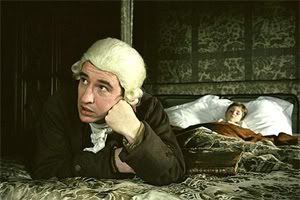
Tristram Shandy: A Cock and Bull Story (2005)


With a movie like this, you either go along for the ride, or you don't. I did. When Steve Coogan teams up with Michael Winterbottom and Rob Brydon, I'm bound to. And while the humor with this group usually has a lot of ups & downs, I didn't ever feel bored during Tristram Shandy. Coogan plays himself playing himself quite well, and his self-deprecation is pitch-perfect.

All the meta levels of the film work quite well. It was particularly fun watching the adult Tristram Shandy introduce, and then critique, the actor playing his childhood self. I also appreciated the various transitions where people slip in and out of character, or where the crew step in and out. That was all handled really well, and made it a lot of fun. In the last half, though, as the film gets more and more tied to the off-screen stuff, it loses some of its vigor.

It was a fun film, but felt a bit slight. When it was all over, I had a lesser version of the same feeling I usually get from PoMo stuff, which is basically the resounding question "Why?" It's easier to find the purpose and meaning behind a Judd Apatow movie, I think, than behind so many of the ironically detached exercises that PostModernists love to love. Still, as I said, that reaction was muted with this movie. Mostly because I did find it so funny, and I think that is mostly down to Coogan's performance.

Thursday, March 1, 2012

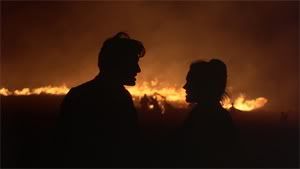
Days of Heaven (1978)


So, I've finally found a Malick film that I'm not wild about. There's plenty to like, and I can certainly see why a lot of people consider it a masterpiece. It's gorgeous, of course—almost every shot is a stunner—and yet that really doesn't detract from the story, which isn't always a given in auteur films. Other technical aspects of the film—the sound especially, and I don't just mean the music—are also quite impressive, and again serve the story well. So far, so good.

But then, there's the actual story. It's certainly pretty standoffish, as far as the emotion goes, but that's so obviously a conscious choice that I have to regard it as disciplined storytelling. The dryness of the telling was certainly in keeping with the film's locale, and the two feed back into each other pretty naturally. So I really didn't mind it. For the most part. I do think, though, that putting Richard Gere in this role was one of the worst casting choices I've ever seen. Especially at this age, Gere is completely incapable of a non-arrogant moment. It's not that he can't display, or even explore, other emotions—sadness, hopelessness, joy, love, envy, or playfulness, for example. It's just that in every one of those moments, his character also seems to be completely full of himself, assured of his own greatness. It doesn't serve this role well. Bill is a character with a lot of brashness, to be sure. It's his driving force, really. But he goes through several significant transformations in the course of the film, and during some of those transitional moments, his self-assuredness doesn't ring at all true. In those moments, the emotional tone of the film doesn't seem dry so much as shallow.

What bothered me much more, though, was the deep misogyny underlying the whole thing. On a second viewing, especially, I was struck by what a slight character Abby really is. If the whole film turns around her, and I think it does, that doesn't mean that she herself is actually important. Rarely does the film, or any one of its characters, ascribe her any real agency. Her fateful decision to go with The Farmer isn't even really her decision, as we're reminded several times. Bill pushes her into it, and she just goes where she's told. Neither does her relationship with The Farmer seem to have any real substance. In a way, she seems to exist simply as an object of desire for both men, and the central conflict of the film is actually just the overlapping of their desires. It's almost homoerotic, frankly. The two men are intimately connected, even though all they really share is a lover.

There's a lot to the film, and I'm certainly glad I watched it (both times). But I didn't come around to it, and I doubt I will try again.

Friday, February 10, 2012

The Little Willies — For the Good Times (2012)

There's a lot to like about The Little Willies' long-awaited sophomore release. They're certainly talented, and can be an engaging listen. But the first and last word that will come to mind as you think of The Little Willies must be "fun." Incessantly, doggedly, sometimes tediously fun. Not that there's anything wrong with fun music, of course, and some of the songs here are as good as they've ever been ("If You've Got the Money I've Got the Time" comes to mind).

One might take a bit of offense to how The Willies strip mine classic songs for the extraction of this one pure resource, of course. Even related notions like rowdiness ("Fist City") or sarcasm ("Wide Open Road") are dispensed with in favor of the distilled product. When virtually every song seems to produce a certain mood, one has to wonder whether it's because every song was approached as a means to that end. After the first half hour or so, one might also start to find the whole exercise a bit monotonous.

To be fair, there are a few moments when they're not extracting every drop of bouncy joy from a tune. Some of these—say, for instance, "Permanently Lonely"—suffer from a certain lack of engagement, and do little to mitigate the overall feeling. But when Jones takes over the microphone for the album's final sequence, she ably sells a wider range of emotion. The title track, "Jolene", and "Pennies on the Floor" are all effective. Gathered as they are at the end, they help the album ride off into a convincing sunset.

To some extent, though, it's that lack of engagement which really defines the album. Like many side projects, the performers often seem unable to fully commit. It has the feel of a backyard barbecue performance, where no one's willing to be accused of taking the whole thing too seriously. There are bright spots—the aforementioned "If You've Got the Money" and the opening track, "I Worship You," are firmly in this mold, and work beautifully. But it's not enough to sustain a full album, and the overall product is inconsistent. For my part, I'll give 3 or 4 stars to a few of the songs, and be glad to hear them when they come up on shuffle play. But I doubt I'll revisit the album itself very often.

Saturday, February 4, 2012

Best Albums of 2011

I'm really late with this, but what the hell.

First, a few honorable mentions....


CultsCults
"Go Outside" is probably about the catchiest tune of all time, and the album as a whole lives up to it. A bit on the saccharine side, though. "Most Wanted"


Zee AviGhostbird
Tighter than her sophomore attempt, but could do with more of that quirky edge that was so great about her first. "Swell Window"


Steve EarleI'll Never Get Out of This World Alive
It's good, and I like it, but it never REALLY grabbed me. "The Gulf of Mexico"


Gregg AllmanLow Country Blues
Falls off a bit in the last half, but a damn good blues album. Definitely my #11 of the year. "I Can't Be Satisfied"


Zoe Muth & The Lost High RollersStarlight Hotel
A bit kitschy, but solid underneath. "Let's Just Be Friends for Tonight"


SaigonThe Greatest Story Never Told
Well balanced, if not overly deep. "Too Long"


tUnE-yArDsW H O K I L L
Normally not at all a fan of edgy/avant-garde stuff, but I loved this in spite of myself. "Bizness"


Lykke LiWounded Rhymes
A lot of fun. A great debut, and another one that really could have made my top 10. "Get Some"

Every year I miss a few good albums. And every year, it seems that at least one of them would have made my Top 10. Last year I missed . . .


#1 2010 Omission: Kele GoodwinHymns
A seductive, beautifully calm album, but one with a lot going on underneath. Goodwin's songs are intricate, woven of iconic—really, mythic—imagery. At the same time, they never seem as fragile as, say, Nick Drake—who has a very similar sound, but not half the depth. I have listened to this album literally hundreds of times over the past year, and I still feel drawn in by it. I can't recommend it highly enough, and I can't wait to hear more from him. [Full review here.]

"Snow" "Hymns" "Feathers"

I don't really consider EPs for the full list, but it seems worth mentioning at least one . . .


#1 EP: Crooked StillFriends of Fall
It's not truly an EP, I suppose, with seven songs, but on the other hand it is just 23 minutes. Twenty-three solid minutes, which have me trusting that they haven't lost what they found a year ago on Some Strange Country. Their sound crystallized on that album, more than it had previously, and it retains that strength here. Their technical proficiency is as present as ever, but they also manage to make just beautiful, engaging bluegrass. They really seem to have hit their stride.

"Morning Bugle" "It'll End Too Soon"

And finally, on to the list proper. I'm sad to say it, but there is really only one artist here that I wasn't already a fan of from previous work. For an array of reasons, I didn't explore a lot of new music this year. And in the last few months, when I usually push myself to really find some new stuff, I just couldn't find anything that felt like it was worth the effort. So I won't rule out the possibility that it just wasn't a good year for new artists, or for surprisingly good stuff from artists I didn't like before. But more likely, I just wasn't stretching out very far. I'm hoping to do better next year, either way. Still, this is a good list, and these are certainly some fine albums.


10.Trombone ShortyFor True
Shorty just keeps doing what he does so well. The musical stew he puts together is as natural as ever, and a lot of fun to get immersed in. I don't mean to say that he's not doing anything new, either, but in a way it seems that that itself is simply a part of what he does. He's tightened up his lyrics/vocals on this one, which I really appreciate, because that's always been a weak spot. Strong, and getting stronger, if this album is any indication.

"Buckjump" "UNC"


9.Florence + The MachineCeremonials
I liked their last album, but there was a layer of complexity to it that always struck me as artificial. This album is a bit more straightforward, and seems more genuine. Honestly, I can see how fans of the previous album might regard this one as too simplistic or something (too accessible, frankly). It does flirt with selling out, I guess, but I doubt they'll ever really cross that line. Here's hoping. The balance on this album is about right.

"What the Water Gave Me" "Heartlines"


8.Danger Mouse & Daniele LuppiRome
With the help of some great work by Norah Jones & Jack White, this composer/producer combo have managed to craft a really wonderful modern-day tribute to the music of so many spaghetti Westerns. It's the kind of project I would normally find uninteresting on many levels, but the artistry here is pretty compelling. They set a real mood from the first few beats, and explore it beautifully for over an hour. If I have any problem with the album, it's probably that it is restricted to that narrow concept—it doesn't break a lot of new ground. Still, it's expertly done, and certainly not difficult to listen to.

"Black" "Two Against One"


7.Black Joe Lewis & The HoneybearsScandalous
I won't be the first or last to say that this album could easily be a lost R&B classic from the '60s. I'm hesitant even to say something like that, though, because it might give the impression that there's something derivative or unoriginal about this music, which there certainly isn't. There's not a false moment on this album, as far as I can tell. It's just sweaty, fun, and desperately good.

"Livin' in the Jungle" "She's So Scandalous"


6.Diana JonesHigh Atmosphere
Jones' songwriting has always been really strong, and for the most part, this album is no exception. Her vocals & musicianship, meanwhile, have never been stronger. There is an anthemic quality to many of these songs, not least the title song itself, and it tends to linger with you long after the last song has faded. [Full review here.]

"My Love Is Gone" "High Atmosphere"


5.Vieux Farka TouréThe Secret
I have to admit, I was a bit concerned when I saw the list of guest artists on this one—which, by the way, includes Derek Trucks, Jon Scofield, and Dave Matthews. Not that the artists themselves were a concern (though Matthews does ruin an otherwise pretty great song), but when an artist like this starts to collaborate with a lot of established American musicians, his work can tend to get diluted in the process. Fortunately, what happens here is very much the opposite. Touré shows plenty of flexibility and competency here, and his music expands quite organically to include these disparate elements. It's his strongest work to date. (And "Gido", by the way, was probably my favorite song of the year.) [Full review here.]

"Gido" "Wonda Guay"


4.Gillian WelchThe Harrow & The Harvest
Welch is really in peak form here—it's hard to see how she gets any better than this. From start to finish, this is a masterful performance—the songs are well written, and beautifully performed. The production is about perfect—textured and engaging. It's her most consistent album, and you can really sink into it. If I have a complaint, it's that the album's boundaries are narrowly drawn. Within them, though, you're in very good hands.

"Silver Dagger" "Down along the Dixie Line"


3.BeirutThe Rip Tide
After Zach Condon's last couple of releases, I really thought Beirut would just fade from consciousness. I almost didn't bother giving this a listen, and what a mistake that would have been. With one exception (the misguided "Santa Fe"), this album marks a real return to form for Condon. Instrumentally, he's back to the eastern-European instrumentation where he is so comfortable. Musically, though, he's begun to really outgrow any such easily identifiable influences. This is probably his most original album, and it's very strong.

"Goshen" "Vagabond"


2.Thao & MirahThao & Mirah
Even for two such diverse artists, this album is pretty unexpected. Really, it should be considered a trio with the producer, Merrill Garbus (of tUnE-yArDs—see above). And it's a very fruitful collaboration. All three take risks throughout, and it's obvious that they weren't settling for just experimentation. Each idea is cared for, nurtured, fully realized, and virtually every one lands. The sound may be sparse, or it may be flooded with random noises. The song may be intricately composed, or have a thrown-together quality. The performance may be careful, or it may be joyfully spontaneous. But in each instance, it works. [Full review here.]

"How Dare You" "Hallelujah"


1.Eilen JewellQueen of the Minor Key
I fell in love with this album right away, and then I kept waiting for that initial reaction to fade. I'm still waiting. Eilen Jewell is one of the strongest songwriters around, and she & her band give a hell of a performance. This album is a tour de force, exploring the disparate cross-genre territory that can only be called Americana. (You might say the same thing of her entire career, actually.) If there's anything that intimidates Jewell, she has yet to find it—whether on a fast rocker like the title track, a dirge-y torch song such as "Only One", or even a novelty track like "Bang Bang Bang", Jewell and her band simply don't fail.

"Home to Me" "That's Where I'm Going" "Reckless"

___________________________


By the way, if you're interested, I threw together a playlist of all the songs mentioned here. They are in this order, so there are some pretty rough segues, but there it is.

Saturday, July 16, 2011

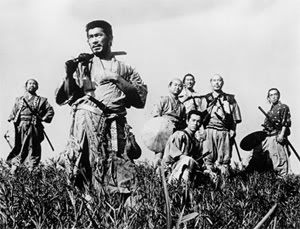
Seven Samurai (1954)


I'm surprised at how much I enjoyed this movie. First of all, not to sound pedestrian, but I'm impressed that a Japanese movie from the '50s was able to keep my interest for 3+ hours, much less to be as fun as it was to watch. Secondly, one of the main characters (Mifune's Kikuchiyo) should have really annoyed the hell out of me, but he didn't. This is a little bit due to some great writing—he's a beautifully complex character—but even more due to Mifune's performance. Believe it or not, this is the first movie I've seen him in. He was really engaging to watch, throughout. I have to say, though, that Takashi Shimura was the actor that really brought me into the film. His charisma reminded me most of John Wayne—just this smoldering presence on screen, who won't allow you to turn away from him.

The film itself was superbly made. It really isn't difficult to spend 3 hours with these characters. The ensemble cast is well filled out, with great roles well performed. At least four of the samurai, as well as quite a few of the villagers, had compelling arcs to follow. The female characters were not so present, unfortunately. Obviously there was a tendency to that, since all of the samurai were men. Shino is a real presence in the film, but it would have been nice to hear more from other peasant women. One or two have moments where you catch a glimpse of a backstory, but they could have been given more time. Obviously I'm not arguing that the film should have been longer, but surely we could have spent less time dwelling (for instance) on the drunken samurai in town who takes their rice and then cowers in his bunk.

I did enjoy the love-story subplot with Shino and Katsushiro. Their discovery of each other was engaging, and their relationship beautifully exemplified the tension between the samurai and the farmers which underlies the entire story. That class tension was the most interesting aspect of the movie, especially as Kurosawa mostly chose to work with it in oblique angles. The final scenes—where the surviving three samurai watch the farmers joyfully going about their work, and we watch Katsushiro struggling with his choice to leave—are the most poignant of the film. (One thing I did love about that, by the way, was that Shino had already made her choice, and she didn't simply cling to him, begging him not to leave. One wonders, if he'd chosen to stay, whether she'd even have let him.)

Aesthetically, Kurosawa is of course a master. I really enjoyed his sense of composition throughout the movie. While not many of the shots are as dramatic as, say, Ran, they have a subtle beauty—and often a subtle significance—that really makes them stand well on their own. And finally, not to drag this review on, but I was really affected by the brief appearance of the flag. There is a lot going on there, touching on elements of nationalism, solidarity, and the power of symbols, which I found myself really thinking about in a new light. It certainly wasn't the most conspicuous symbol in the film (the four swords sticking out from the graves would probably take that honor), but there was a kind of magic that took place in the making and use of that flag that was more than the sum of its actions.

I enjoyed this film even more than I expected to. I responded to Ran largely in that I recognized its significance. Not to say I didn't enjoy it, but that enjoyment was perhaps outweighed by my appreciation of it. Those proportions were reversed for this film. While I did appreciate its significance (e.g., I really want to see The Magnificent Seven now), mostly I enjoyed watching it (and so I really want to see The Magnificent Seven now).