Thursday, July 26, 2012

Murder on the Orient Express (1974)


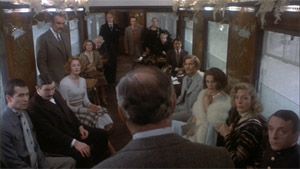
If this film is evidence of anything, it's that a collaboration among the best & brightest doesn't always produce the greatest result. Story by Agatha Christie. Directed by Sidney Lumet. An all-star cast, including Albert Finney, Lauren Bacall, Ingrid Bergman, Sean Connery, John Gielgud, Anthony Perkins, Vanessa Redgrave, and Richard Widmark. This thing can't fail.

And it doesn't, exactly, but it really doesn't succeed either. There are a few of the standard Poirot lines ("What a funny little man", "You're Belgian? I'd thought you were French."), but no real wit. Nothing popped; the movie just plods along through a fairly routine (and largely telegraphed) whodunit. From that entire cast of stars, there's not a single noteworthy performance. The best thing you can say is that some of them managed to really disappear into their roles (Finney & Bergman, especially). But what a movie like this wants is some sparkle, some charm. Only Perkins, of all people, brings any of that, and it's certainly not enough to go around.

And finally, I have to mention the two lengthy scenes near the end—the re-enactment of the deed, and the champagne toasts. Both were given entirely too much time and attention. I can't say much more without a spoiler, but they really drew out the end of an already too-long film, and to no positive effect.

Wednesday, July 25, 2012

1974

Over at the Filmspotting forum, they do this thing which is a bit hard to explain . . . collectively, we all pick a past year, and then we watch a lot of the movies (focusing, of course, on the ones that seem to be the best). Then we participate in discussions & votes, and eventually grant awards. The typical stuff, mostly—Best Picture, Best Director, etc.—along with a few more interesting ones like Best Line.

I'm enough of a non-film-geek that the last time they did this, it sounded lame. But I'm enough of a geek that this time, it sounds interesting. So, we've picked 1974, and I'm going to go along for the proverbial ride. To some extent, at least—we'll see how many movies I watch for it, and how much I participate in the discussion.

Sunday, July 15, 2012

Terminator 2: Judgment Day (1991)


I'm not sure how much I'll have to say about this film, but it's a legitimate classic. I have some gripes with it—the rehashed battle scene at the beginning, the gratuitous images of a playground full of children being incinerated, and of course the completely superfluous narration. But those are relatively minor quibbles, and overall I enjoyed this quite a bit.

Following that opening battle sequence, we cut straight to the familiar scene of an arrival from the future into the present. This is better, on a technical level, than it had been in the previous film, and the follow-up (also familiar—the "Give me your clothes" scene) is better on a dramatic level. It's clear that more money was spent on this film, but also that more talent was at work on it. This is good, because while both films are strong pieces of science fiction, what really carries them both is the human story. And in this case, it carries quite a bit further than it had in the predecessor.

There's a level of intensity to the film from early on, and it's masterfully sustained. This is the case in spite of already knowing some of the major surprises (such as which visitor from the future was here to help and which wasn't), and even through some literally very dry scenes in Mexico. It's beautifully shot, reasonably well written, and the special effects are really remarkable even two decades later.

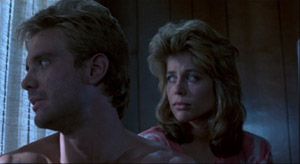
But mostly, it's well acted. I knew going in that Linda Hamilton was going to be the core of the movie, and I wasn't wrong. I was even impressed with Schwarzenegger, though, and with Robert Patrick. Ed Furlong wasn't so impressive, but he didn't drag it down. Still, it's Sarah Connor that really drives the story. The scenes that focus on her are the best throughout—tense, gripping moments that both hold the movie together and keep it in your mind after the credits roll.

It was a lot of fun to watch, and I'm already ready to give it another go. It wasn't a masterpiece, I don't guess, but it was awful good.

Tuesday, July 3, 2012

The Terminator (1984)


There's something enjoyable about this movie that's difficult to clearly identify. For starters, it's easy to underestimate the value of a great credits sequence, which this certainly has. The screen practically pulses with the gliding outlines of bold, futuristic logo text, and the synth score is a relatively minimal flow of ominous tones. It's nothing terribly flashy, especially by today's standards, but it lends a gravity to the film that will help to carry it along.

Then too, watching this for the first time in this day & age, it's nearly impossible to consider it apart from its acclaimed sequel. Like the character of Sarah Connor herself, this is a movie borrowing much of its significance from the offspring it will produce.

It's difficult, upon any reflection, to find a lot of value in the film itself. It's severely outdated in many respects—that score, certainly, and many of the special effects—and it does lean on those elements fairly heavily. As for the plot, it is utterly predictable (other than a brief, creepy interlude when it seems that Kyle Reese might actually be John Connor, just as the blossoming romantic subplot is about to bloom). That said, the actors' commitment to their roles does keep the whole enterprise afloat. And the special effects near the end—featuring the stripped metallic body of the terminator—are spectacular. So it was, overall, fun to watch.

It's worth seeing, I hope, but as Reese points out, the future I'm expecting is only one possible destiny. And if it goes poorly, this picture will look much less rosy in retrospect.

Thursday, June 21, 2012

All about Eve (1950)


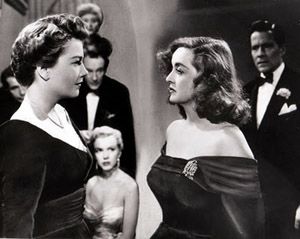
I had several problems with this film, but let me start with a few of the more minor. First of all, the characters seem more like...well, more like characters than actual human beings. There is very little depth or complexity to anyone—provided one doesn't confuse flakiness with complexity, but more on that in a minute. (The one exception is Thelma Ritter, who of course has more natural charisma and substance in her lower lip than most actors have in their entire body.) It's not just that people seem stiff, although for the most part they do. It's more than there seems to be nothing unseen, nothing that isn't there to fill out a generic character type or propel the plot.

Speaking of which, back to the question of flakiness vs. complexity. I'm all for inconsistency in a character's actions, so long as it seems to come from some depth or internal contradiction. That's the essence of drama, but it's not what's happening here. When the plot needs Margo to turn on Eve, she simply does so—there is very little evidence of any internal struggle. Karen Richards follows the exact same hairpin arc when it's her turn to further the storyline, and with only slightly more sense that something's at stake. The men, of course, are just so many set pieces, serving the same purpose that women tend to serve in a more traditionally misogynistic film—they exist to prove something about the characters of the opposite sex, or about gender relations at large, rather than to be identifiable personalities in their own right.

Not that the film is any less misogynistic for it, of course. Two of the three female leads are flakes, and the other—Eve herself—is a cardboard cutout. We're never given much of a clue as to her motivation, probably because even the filmmakers didn't think it would be very interesting. She's an ambitious ingenue, who will step on anyone in order to get up a rung. That's all the treatment she gets, but surely even she could have been much more intriguing. Her most captivating moment is indeed when she flashes her vicious side in the one-on-one with Karen, but why couldn't we at least have more of that? She plods through most of them film so robotically that it seems she has no drive at all.

Which brings me to yet another issue. The film is, of course, 'about' gender issues. In show business specifically, but in society in general. But at least as interesting a subject, especially given the question of Eve's motivation, would have been the issue of class. Which is thoroughly—systematically, even—avoided. Even as Addison DeWitt compares himself to Eve while simultaneously claiming to 'own' her, we're never given to ask why—why would one such person end up with all the power, while the other ends up trapped even in her own success? It's a bit to do with gender, yes, but as he himself lays out the case, it's obvious: the real issue is that her name is Gertrude Slojinski, while his is Addison DeWitt. She has had to fight and scrape her way up, while he has simply waited for her at the top. Eve's greatest sin isn't being a woman. It's being a climber.

And finally, if I can return to more minor complaints, the film is just so dry. Some films do well with a lot of dialogue, but this isn't one. Primarily because it isn't dialogue, so much as exposition and real-time analysis by the characters themselves. It could have been 45 minutes shorter, and an awful lot tighter, if they had just shut the hell up once in a while and let things happen.

In spite of these complaints, it's not a terrible film. There are moments of good acting, especially from George Sanders and the aforementioned Thelma Ritter. And there is a worthwhile, interesting story hidden in there somewhere, even if it's obscured by a lot of talking about it and looking in the wrong direction most of the time. This is one film that I'd love to see redone, especially with an eye to more tension and suspense.
Sunday, June 17, 2012

The 400 Blows (1959)


This film is like a smoldering fire, that never flares very high, but steadily, inevitably consumes its protagonist. Jean-Pierre LĂ©aud does an amazing job in the lead role, setting the temperature of the entire film with his stoicism and reserve. He is in virtually every frame, which is a bit ironic since so much of what happens depends on everyone but him. The result is a claustrophobic sense of powerlessness. The audience is never given a way (or a reason) to identify with Antoine's parents or teachers; the world is simply there, at every turn cruel to varying degrees, but without any definitive reason why.

The whole of the film is masterfully designed and executed. Its boundaries are narrowly drawn, and within them it seems entirely complete. Truffaut's work is solid, plain, and immersive. Léaud's performance is well supported by those around him, especially his friend René, who is really the agent of Antoine's downfall, but without any malice or false intent. The contrast between the two is a subtle but illuminating study in what it takes to get ahead in the world.

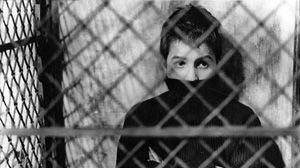
Really, fire is the wrong metaphor for this film. Antoine isn't so much consumed as he is trapped. The movie's events unfold like a game of chess, and try though he might, he can't avoid that end. Still he never seems desperate, or for the most part even unhappy. The one exception—and certainly the most powerful moment in the movie—is his ride to the Observation Center (which parallels the marvelous opening-credits sequence). LĂ©aud is in full control here, as we see the weight of misfortune settle heavily onto Antoine's shoulders. Still, he's soon back to his stoic self. In the end, though he has no clear path to a better life, as he stands on that seashore he does seem to have a glimmer of hope in his eyes. Here, as throughout the movie, one can't help but feel it with him.

Friday, June 15, 2012

The Red Shoes (1948)


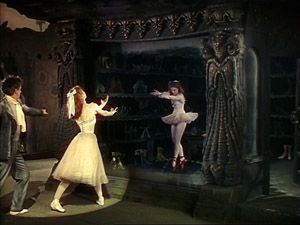
What a revelation this film was. I generally try not to know much about a movie before I see it, and films like this really reward that diligence. I had no expectation going in that I'd see the kind of magic that The Archers put together here. It's a great balance, really, because so much of the film is just straightforward, natural narrative. But in a few moments, and of course in the eponymous extended dance sequence, it slips very naturally into something else. I was searching for what to call it—words like 'surreal' and 'magic' don't seem to fit at all—when I ran across the perfect phrase in a British review: "quietly radical." It's not designed to shock you. It's not even designed to amaze you. It's just that the filmmakers make full use of their medium, while keeping everything perfectly in line with the story they're trying to tell. They manage it beautifully—I was more impressed with their ability to do that than I was with the technical wizardry itself, which is exactly as it should be.

The story itself is not overly original, but it's well told. The more traditional scenes of the film were typically well crafted, of course. The narrative is absorbed in the world of the ballet. As usual with The Archers, the techniques are subtle, but effective. Much of the action takes place in long shots, for example—we often see three or four main characters on screen. Everything seems to happen in a larger context, and the story isn't dominated by the very strong personalities within it. They certainly are strong, though, and propel the story forward nicely.

I did find myself comparing it to (or maybe rather, considering it alongside) Black Swan, and it really has me wondering about this common trope of a woman's self-destructive obsession with her art. Not that there aren't similar male tropes, and not that there aren't other obsessed-female character types. But from Sunset Boulevard through this film and on to today, it seems that a woman is never allowed to be too devoted to her art. It's difficult to imagine such films with the gender roles flipped.

It isn't really a problem (internally) with this film, mind you. Vicky is a full character, not just a trope, and her development as a character is enthralling to watch. Shearer gracefully toes the line between naturalistic and romanticized acting, and it serves the story well. The same is true, by the way, of the two male leads. Anton Walbrook's Lermontov is especially charismatic. He's difficult to love, but hard not to pay attention to. (I don't mean to tie this film too much to Black Swan, but that film would have been greatly improved if Thomas Leroy had been written & performed with more of this subtle charm.)

The Red Shoes was a thrill to watch, and I'm grateful to Filmspotting for turning me on to it. And to The Archers overall—I can't wait to see more from them.

Monday, June 11, 2012

The Tallest Man on Earth — There's No Leaving Now (2012)

Kristian Matsson's music doesn't so much have rough edges as it does rough surfaces. There's an ever-present struggle in his voice, and to a lesser extent in his playing. He seems always to be a bit beyond his comfort zone, stretching to reach a higher note or a more expansive idea. It's easy to be fooled, but that unfinished sound belies the solid structure underneath. In a sense, what makes the music so compelling is that tension between the easy, solid base and the gritty, rough-hewn surface. There is an easy confidence in the songwriting; it's music with a lot more heart than head.

If the music is dependably good, that isn't to say it's static. TMoE is breaking new ground on this album, departing from the guy-with-a-guitar sound that has comprised virtually his entire catalog up to this point. If you stop and pay attention, it's not difficult to imagine how a song like "Revelation Blues" would sound without the atmospherics, rhythm section, etc. But if you take it all at face value, the sound is quite organic.

Nothing sounds like it should be stripped bare, even if you can hear how it could be. The focal point is still Matsson's intricate picking, and that's as gorgeous as ever. If the additional instrumentation & production don't seem integral to the end product, they do add a freshness to his music. This seems like the most organic direction for TMoE's music to grow, and it's good to see him working his way into it.

Mostly, There's No Leaving Now is shot through with grace and beauty. Sometimes it's the songwriting, as on the title track. Often it's Matsson's guitar playing. Occasionally it's just the straining of his voice in fleeting moments, as in the final track. It's another masterful album, which certainly holds up to the high expectations that are resting on it.

Monday, June 4, 2012

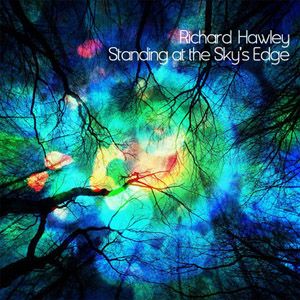
Richard Hawley — Standing at the Sky's Edge (2012)

Richard Hawley's latest album, like one or two before it, fades in slowly. As the sound rises from nothingness, you'll be forgiven if you expect his typical reverb-laden Rickenbacker sound to wash over you. Don't get too comfortable, though—when this album comes on, it hits like a brick wall. With the opener, "She Brings the Light," Hawley is clearly in new territory, and he spends most of the rest of the album exploring it.

There's never been a real throughline in Hawley's album releases. He has always had something of a signature sound, to be sure, but his development from album to album hasn't always followed a clear course—he hasn't been consistently getting heavier, or lighter, or grander. Still, this album feels like a real departure. Beyond the wall-of-sound opening, he's working here with a lot of sonic elements that aren't familiar from his previous work. The title track's bongo interlude, for instance, or the spacey over-production of "Time Will Bring You Winter," will surprise longtime fans. The thing is that these elements work—the sound is mature, fleshed out. If this were the first Richard Hawley album you'd ever heard, you'd have to assume he'd been developing exactly this sound for quite some time.

He does momentarily return to more familiar ground for the pairing of "Seek It" and "Don't Stare at the Sun." They're not bad, but it's not the best material here. Certainly, they don't integrate seamlessly into this album—in the context of so much volume, such songs take on a quaintness that doesn't well suit them. Then again, perhaps it's that Hawley himself is moving on from such spaces, and his lack of engagement is showing. "The Wood Collier's Grave" seems to indicate the latter—simple as it is, it works beautifully, and tracks perfectly back into the crashing "Leave Your Body Behind You." Evidently, Hawley is ready for  a new sound. But if this album is any indication, he'll be just as comfortable and masterful as ever.

Thursday, May 31, 2012

The Day of the Jackal (1973)


For a hitman thriller, there's remarkably little action in this film. The pacing seemed a bit slow as it went on, but only afterward did I realize how successful it had been at maintaining tension throughout the 2-hour–plus runtime. Through the first half or so it focuses almost entirely on our protagonist's methodical preparations for the act. Edward Fox carries us through this handily, his air of quiet nerve a prototype for characters in the genre. He turns this into a wonderfully sympathetic character. I don't want to say that I managed to forget he was a hitman, but actually it was more like I forgot what makes a hitman a hitman. So the first time Fox kills someone, I actually gasped. I saw it coming, I suppose, and yet the performance of it was very much an icy-cold shot of water in the face.

As this lone-actor story begins to blend with the detective story that's been building on the other end, things get considerably more interesting. The most intriguing performance of the film—and my favorite character overall—is Michael Lonsdale as Lebel. His dogged, intelligent determination is beautifully counterpointed by his quiet, controlled demeanor, and together with Derek Jacobi's supporting role, the investigation quickly becomes the driving force of the film. The tension becomes outright suspense, and carries the film through to its climax—which is a bit rushed and a bit incredible, but not enough to really hurt the film. Even if it had, the coda that follows is rich enough to revive it.

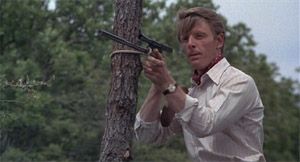
It's a very well crafted film—not showy, but effective, and some of the minute details were really delicious (e.g., his technique for practicing with the rifle, pictured above). It could have been a bit less dry, I suppose, but it simply isn't that kind of film. I enjoyed it as it was.